5 Terrific High-End Technical Skiffs

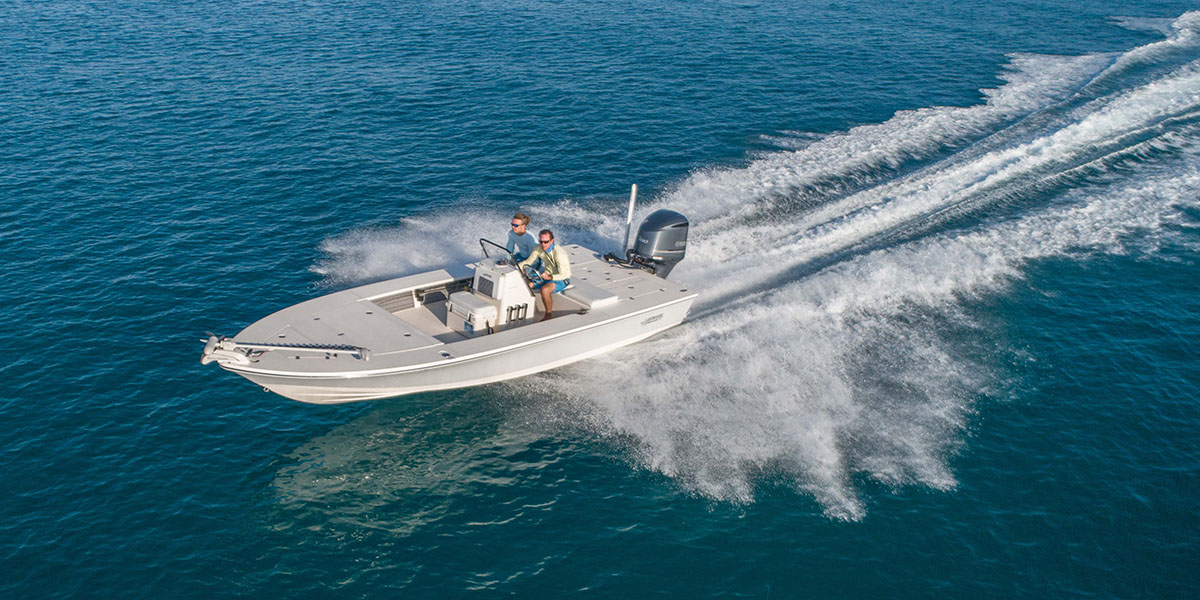

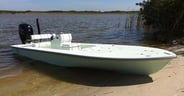

When it comes to skiffs, buyers have options. They can shop at the budget end of the spectrum and find plenty of honest boats that do honest work. At the other end of the spectrum, they can look at high-end technical skiffs that are manufactured with lightweight materials, packed with more fishing features, and powered by larger outboards.
Working in outdoor media, I have occasionally found myself aboard high-end technical skiffs I wasn’t in a position to buy. That can spoil a person. The price, though, is rarely what stays with me. I remember the hull that landed softly after crossing a ferry wake. I recall that the boat needed almost no correction from the poling platform in a quartering wind. My ears remind me of the closed hatch that sealed tight without drumming across the flat.
Those details separate an expensive skiff from a genuinely technical one. We’ve taken the liberty of assembling a collection of skiffs for discerning buyers who won’t balk at a premium price tag.
Hewes Redfisher 21

Base Price: $78,731 (w/Yamaha VF250XB)
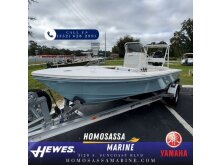
Built by the Maverick Boat Group, the Hewes Redfisher 21 is the most conventional production boat here, and that isn’t an insult by any means. The 15-degree hull, 14-inch draft, ARIS-infused construction, standard jack plate, 50-gallon tank, and 44-gallon aft livewell make it a serious backcountry and nearshore platform without asking an owner to manage a fully bespoke build.
This isn’t the boat I would choose for all-day push-poling over ankle-deep water. Instead, consider this one if you’re trying to catch bait in one bay, run through an inlet, fish outside, and return—with three anglers and a lot of gear. The 350 hp rating leaves room for extreme tournament setups, but a 250 will make more sense for many owners once weight, fuel burn, and balance are considered. Its advantage is how complete and repeatable the package is.
Additionally, the Redfisher will most likely appeal to an experienced angler who wants premium construction without turning the build process into a part-time job. Buyers have meaningful decisions to make—engine, steering, livewell plumbing, trolling motor, and shallow-water anchors—but the underlying package has been standardized and documented.
Specifications:
- LOA: 21 feet, 6 inches
- Beam: 8 feet, 6 inches
- Weight: ~2,850 pounds with engine
- Fuel capacity: 50 gallons
- Maximum horsepower: 350
Hell’s Bay Boatworks Estero

Base Price: Consult builder
The Hell’s Bay Boatworks Estero is more of a bay boat, not a push-pole skiff, but its construction follows familiar Hell’s Bay priorities. It features a carbon/Innegra hull, vacuum-infused Corecell structure, vinylester resin, incorporated spray rails, and carefully gasketed storage. The 53-gallon baitwell and 130-gallon in-floor fish box make its primary function obvious. This is for anglers carrying bait, making exposed crossings, and fishing beyond the backcountry.
In Yamaha testing, an F300-powered Estero reached 57.4 mph at a 4,210-pound test weight. Its best reported economy was 4.19 mpg at 21.6 mph. Those numbers say more about the useful operating envelope than an unloaded top-speed claim.
Estero’s technical advantage isn’t extreme draft, but rather the integration of range, bait capacity, and steering into a boat that can work an open bay quietly. For guides, live-bait tournament anglers, and owners making regular inlet or nearshore runs, that’s a more relevant definition of “technical” than how easily the boat accepts a push pole.
Specifications:
- LOA: 24 feet, 10 inches
- Beam: 8 feet, 6 inches
- Weight: 3,100 pounds
- Fuel Capacity: 80 gallons
- Maximum Horsepower: 400 hp
East Cape 21 EVO

Base Price: $117,500
East Cape currently calls this model the 21 EVO. Its numbers put it squarely in hybrid territory: 21 feet, 6 inches long, 100 inches wide, a 14-degree deadrise, a delta pad, and power up to 300 hp. The 90-gallon fuel tank is extraordinary capacity in a 21-footer and a clear statement about purpose. This boat is meant to cover water.
That tank can carry roughly 500 pounds of fuel, so the 21 EVO should be evaluated as a loaded system, not an empty hull. East Cape advertises a nine-inch draft and 60-plus-mph capability, but the test I would insist on is quieter: trolling motor off, two anglers aboard, quartering wind, then pole it from a dead stop. That reveals more about hull entry, windage, and static trim than another wide-open throttle pass.
Specifications:
- LOA: 21 feet, 6 inches
- Beam: 8 feet, 4 inches
- Weight: Not listed
- Fuel capacity: 90 gallons
- Maximum horsepower: 300
Chittum Skiffs Islamorada 21

Base Price: Consult dealer
The Chittum Skiffs Islamorada 21 is the closest boat on our list to a traditional technical poling skiff. Chittum stretched it to a size that can carry more people and fuel and provide improved weather capability. Its 12-degree bottom, 10-inch pad, high-volume spray rails, staggered split chine, and radius transom aim at a difficult compromise: run like a larger boat without becoming clumsy when the push pole comes out.
The distinction between this boat and the 21R is important. The standard Islamorada 21 can be built around a relatively light 115 hp outboard and still exceed 50 mph, preserving the balance that makes a push-pole boat useful. The Chittum 21R is the high-horsepower tournament version. If you buy the biggest engine available without understanding that difference, you risk turning a remarkably capable poling platform into something stern-heavy and less pleasant at idle.
Specifications:
- LOA: 21 feet
- Beam: 7 feet, 4 inches
- Weight: 900 pounds unrigged in 100-percent carbon construction
- Fuel capacity: 32 or 38 gallons
- Maximum horsepower: 200
Beavertail Skiffs Lightning 20

Base Price: $67,900
The performance specialist on our list of high-end technical skiffs is the Beavertail Lightning 20. It uses a stepped hull to reduce wetted surface and can be rigged from its standard 150 hp up to 300 hp. Those aren’t merely different engine choices either; they create different boats. Engine mass, setback, propeller selection, and jack-plate height change the hole shot, bow carry, running angle, and how settled the hull feels when it comes off plane.
At 82 inches wide, the Lightning is notably narrower than the East Cape and Redfisher high-end technical skiffs. That can help efficiency and reduce the broad, wind-catching feel of some big flats boats while leaving substantial forward deck and 360-degree fishability. The 35-gallon livewell and convertible aft compartments also reveal its tournament intent. Anyone ordering 300 hp should sea trial that exact power, prop, and setback combination.
Stepped hulls reward good setup and expose lazy setup. The fastest configuration may not be the one that carries a tournament load most cleanly, holds plane at the lowest speed, or feels the best when crossing an opposing wake. Prop testing, engine weight, and weight placement are part of the purchase—not chores to address after delivery.
Specifications:
- LOA: 20 feet
- Beam: 6 feet, 10 inches
- Weight: 1,200 pounds
- Fuel capacity: 48 gallons
- Maximum horsepower: 300
Marketplace Inventory

 David Schlake
You might also like


