5 Aluminum Bass Boats You Should Check Out

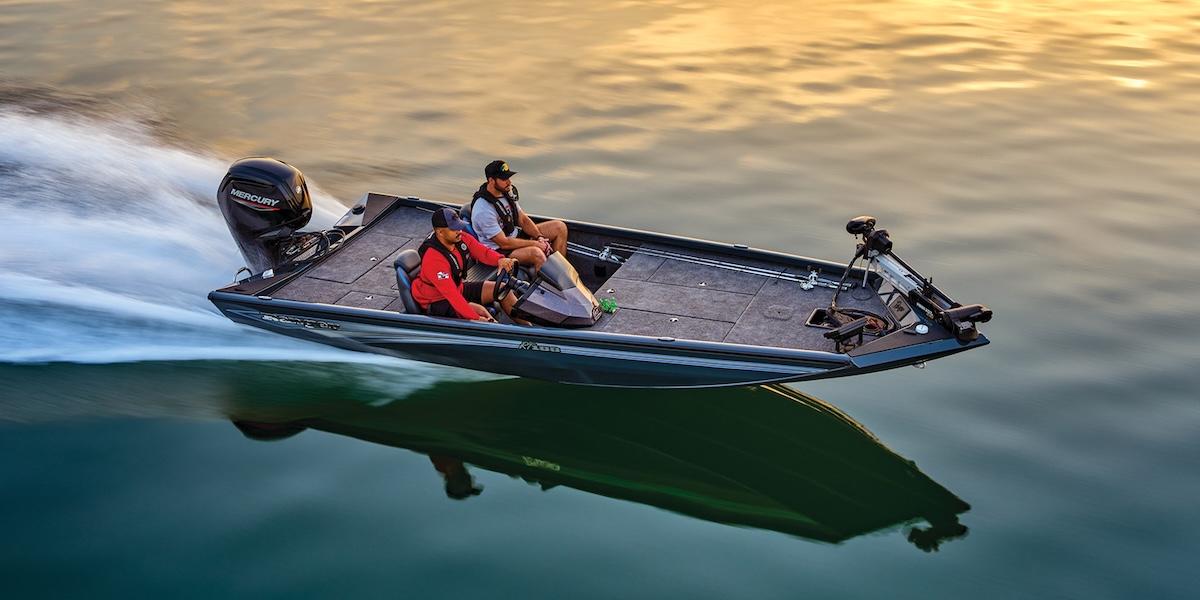





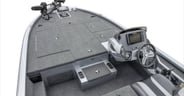
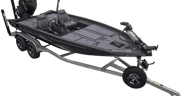
I’ve spent a good portion of my life fishing out of aluminum bass boats. I have seen all of the faster, wider, and considerably more expensive rigs, but never felt much urgency to get away from the aluminum models. My dad and I have fished out of a Tracker Pro Team 175 for years. It isn’t exotic, nor is it particularly fast. Nobody at the ramp is going to stop unloading their boat to come admire it. But, man, it works.
That counts for a lot when you actually fish. We’ve dragged that Tracker to lakes, backed it down questionable ramps, bumped it into cover, and loaded it with more rods and tackle than two people reasonably need. It’s always done what aluminum bass boats are supposed to do: launch easily, fish shallow, give two anglers enough deck to work, and get everybody home.
What has changed is how far the category has stretched beyond that basic formula. A modern aluminum bass boat can still be a relatively simple 17-footer with 60 hp, but it can also carry a 200 or 250 hp outboard, hydraulic steering, a 36-volt trolling motor, multiple large-screen electronics, forward- or side-facing sonar, and enough livewell capacity for serious tournament duty.
Hulls have become more sophisticated, decks have gotten wider, and the better builders are paying attention to details—pad geometry, lifting strakes, weight distribution, storage placement, electrical capacity—that used to separate aluminum fishing boats pretty sharply from their fiberglass counterparts.
That makes shopping for one more complicated than deciding how much horsepower you can afford. The real differences show once the boat is loaded with fuel, batteries, tackle, fish, and two anglers trying to fish from the same casting deck. The five aluminum bass boats we highlight here approach that problem very differently.
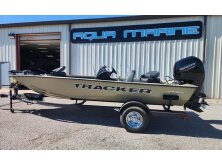
Tracker Pro Team 175

Base price: $23,995 (w/Mercury 60 FourStroke and trailer)
I have to start here. Tracker’s current Pro Team 175 remains the baseline because the package is complete and its compromises are easy to understand. The 0.100-inch 5052 hull has a 5-foot bottom and 10 degrees of transom deadrise.
Tracker estimates 35 to 37 mph with the standard 60 hp Mercury and 40 to 41 mph with a 75 hp engine. That’s good enough for smaller reservoirs, rivers, and club tournaments where the run is measured in miles, not counties.

The weak point is the standard 45-pound, 12-volt trolling motor. It works in calm water, but current, vegetation, and spot-lock fishing make the available 24-volt conversion a sensible upgrade. A 21-gallon divided livewell, storage for 16 rods, and six 3700-size tackle boxes aft are genuinely useful at this price.
Specifications:
- LOA: 17 feet, 7 inches
- Beam: 7 feet, 5 inches
- Dry weight: 1,050 pounds
- Fuel capacity: 21.5 gallons
- Maximum horsepower: 75
Vexus AVX1880

Base price: $45,650
The Vexus AVX1880 makes its case with refinement rather than brute horsepower. Vexus uses 0.125-inch aluminum on the bottom and sides, plus a pad hull, computer-modeled lifting strakes, integrated spray rails, and stretch-formed gunwales. Carrying the beam forward creates width where the bow angler stands instead of merely posting an impressive number at the console.

SeaStar Pro hydraulic steering, an 80-pound Ultrex trolling motor, four-gauge trolling motor wiring, a three-bank charger, and a fiberglass livewell with pumpout are standard. The 20-gallon well Vexus includes is adequate. Anglers carrying heavy limits in hot weather, though, should consider the optional oxygenation package.
Specifications:
- LOA: 18 feet, 10 inches
- Beam: 95 inches
- Weight: ~3,000 pounds (with engine and trailer)
- Fuel capacity: 35 gallons
- Maximum horsepower: 115
XPress X19 Pro

Base price: $45,495 (w/Yamaha VF175LB)
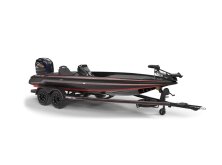
Let’s call the XPress X19 Pro the performance choice on our list of aluminum bass boats. Its Hyper-Lift hull combines a 67-inch bottom, a 95-inch beam, 0.125-inch 5052 construction, and a 200 hp maximum. The current boat includes a 6-inch jackplate, and Xpress recommends a plate with 150 hp or more. Engine height, setback, propeller pitch, and stern load determine whether the hull carries cleanly or simply runs bow-high.
Historical Yamaha tests show the range: A 175 hp X19 Pro reached 60.3 mph at 2,427 pounds, while a 200 hp version reached 70 mph at 2,632 pounds. Both used 10-inch manual plates, so those figures are not promised for the current package. They do show how strongly the hull responds to setup.
The 40-gallon gas tank also gives an angler control over load. Running half a tank saves roughly 120 pounds. Where batteries, anchors, and tackle sit relative to the pad matters just as much.
Specifications:
- LOA: 19 feet
- Beam: 7 feet, 11 inches
- Dry weight: ~1,390 pounds
- Fuel capacity: 40 gallons
- Maximum horsepower: 200
Ranger RT188

Base price: $35,995 (w/Mercury 115 FourStroke Command Thrust and trailer)
Do not confuse the Ranger RT188 with the pad-hull RT188P. The standard boat is the steadier platform thanks to its 0.100-inch aluminum, 64-inch bottom, 92-inch beam, and 115 hp rating. Will it run with the Xpress? No. But its stable deck, predictable low-speed behavior, and hull that doesn’t demand constant setup work can combine to win at fishing time.

Flotation foam helps suppress vibration and hull noise. The standard 70-pound, 24-volt trolling motor is realistic for tournament use, and the fiberglass console accepts a 12-inch display. Verify the steering when you order: Ranger lists no-feedback steering with automatic hydraulic upgrades to certain engine packages.
Specifications:
- LOA: 18 feet, 10 inches
- Beam: 7 feet, 8 inches
- Dry weight: ~1,240 pounds
- Fuel capacity: 22 gallons
- Maximum horsepower: 115
Lund 2075 Pro V Bass XS

Base price: $68,565 (w/Mercury 200XL FourStroke)
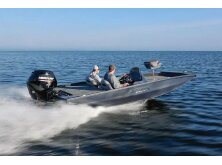
If our list of aluminum bass boats has an outlier, it is the Lund 2075 Pro V Bass XS, which is exactly why it belongs. At 20 feet, 10 inches, 1,850 pounds, and up to 250 hp, it’s closer to a northern big-water tournament rig than a conventional southern mod-V. Its IPS2 hull uses a 0.125-inch bottom, a 0.205-inch double-plated bow section and an 81.75-inch chine. A 20-inch cockpit and 25-inch transom make sense when the ride home crosses open water in an afternoon wind.

The center box accepts 10-foot rods, and the aft livewell holds 28 gallons. Lund wired the bow for a 24- or 36-volt trolling motor. Jump seats add crew capacity without permanently consuming the rear deck. The tradeoff is mass. The published towing weight is 3,380 pounds before personal gear.
Specifications:
- LOA: 20 feet, 10 inches
- Beam: 8 feet
- Dry weight: 1,850 pounds
- Fuel capacity: 49 gallons
- Maximum horsepower: 250
All images are courtesy of the manufacturers.
Find Aluminum and Fiberglass Bass Boats For Sale
 David Schlake
You might also like


