Beneteau Oceanis 52 Review

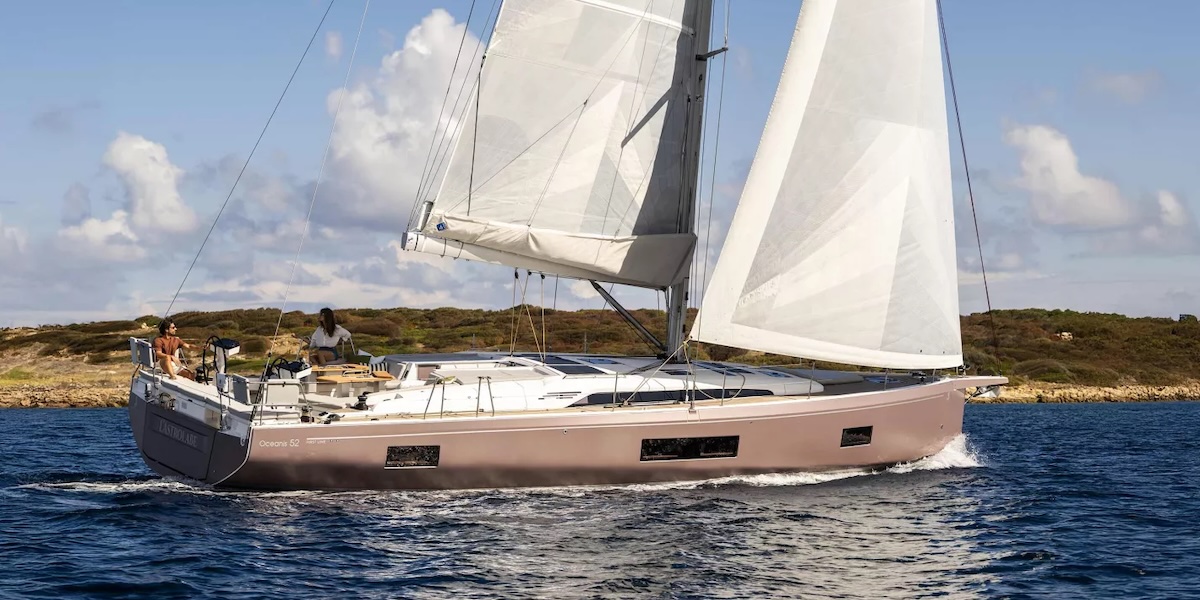


French boatbuilding giant Beneteau is now in the 8th generation of their iconic Oceanis line of monohull cruisers. The new flagship, the Beneteau Oceanis 52, replaces the 51.1, which sold nearly 500 hulls during her reign. The successor is even better in real life than she is on paper.
At a Glance: Beneteau Oceanis 52
BENETEAU OCEANIS 52
Specs
- LOA: 53 feet, 5 inches
- LWL: 48 feet, 2 inches
- Beam: 15 feet, 11 inches
- Draft: 6 feet, 4 inches or 7 feet, 9 inches
- Air draft: 78 feet
- Displacement: 31,905 pounds
- Sail area: 1,453 square feet
- Fuel: 53 gallons
- Water: 111 gallons
- Base price: $720,000
- Price as tested: $994,000
- Designer: Roberto Biscontini
Power and Performance
- Engine: 110 hp Yanmar turbo diesel with Saildrive
- Top speed under sail: 7.4 knots in 11.4 knots true wind at 60 degrees apparent wind angle
- Cruise speed under power: 7.7 knots at 2,300 rpm
- Top speed under power: 8.9 knots at 3,150 rpm
Features We Love
- Diamond-shaped cockpit with 30 percent more space than her predecessor
- 1,539-square-foot Code 0 sail
- Nav desk with nearby library storage
- Electric drop-down transom
- 12-inch Raymarine multifunction display
- Self-tacking jib track
- Sole-to-ceiling open storage
- Dinette with an electric high/low table
- Corian countertops with fiddles
- Upmarket upholstery
Design and Notable Features
Designed by Roberto Biscontini, the Beneteau Oceanis 52 draws heavily on dealer and owner feedback, which produced good results. The pronounced hull chine starts at the plumb bow and her nearly 16-foot beam extends all the way aft to the transom, creating sufficient room for a massive cockpit.

Standout features include her sleek profile, her reconfigured cockpit, and stylish interior features. Of course, another “feature” is her performance. The Oceanis 52 lives like a boat 5 feet longer but is as agile and sails like one 10 feet shorter.
Beneteau Oceanis 52 On Deck
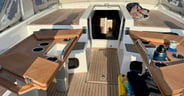
From one end to the other, the Beneteau Oceanis 52 is chock full of nice touches. The standout is the cockpit. It is 30 percent larger than on the 51.1 and has a “diamond” shape. I found it unremarkable on paper, but once aboard, I noticed how this space comes to life.
The “diamond” is formed by twin curved settees on either side. Each has its own high/low table, and the ends of these tables flip up so passengers can easily shimmy onto the settee. The tables lower and convert the settees into large sunbeds with cushion inserts.

Just aft of the benches are two steps on either side that lead from the cockpit to the sidedeck. This resembles Jeanneau’s walkaround deck solution, but it’s better because you don’t need to start that walk from behind the wheels. The secondary winches are right by these steps, which allows the crew to work them without having to kneel on the cushions.
The drop-down transom is electric and is accessed via two stairways behind the wheels. This is where you stand to cook at the optional outdoor galley that has a grill and a small drinks refrigerator. Without the optional outdoor galley, the cockpit remains open and unobstructed with the exception of the seats behind the wheels that lift up and out when not in use. The fuel fill is on the cockpit sole by the starboard wheel rather than on a sidedeck. Knowing that accidental drips and spills are inevitable makes me think this isn’t the best placement.
The binnacles resemble pedestals on superyachts. The starboard one holds a 12-inch Raymarine multifunction display, the windlass control, the power winch buttons, and the Yanmar throttle. I’m delighted to see engine controls up here rather than on the bulkhead at knee level where the driver must look down during docking.
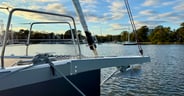
Beneteau moved the lower shrouds inboard, so walking up the sidedecks is an uncluttered affair. Optional solar panels are embedded into the deck (where they make standing by the mast hot and slick). The self-tacking jib track is athwartships just ahead of the mast. The anchor is offset to port and nicely recessed into an integrated composite bowsprit that also holds the Code 0 or asymmetrical spinnaker pad eyes.

On deck, the Beneteau Oceanis 52 isn’t just spacious and comfortable, it also exudes style and luxury with much the same equipment and overall feel as you’d find on an 80-footer.

Salon
Buyers can choose from one of two available layouts. The owner’s version is a three-cabin arrangement, which our test boat had. For charter, there is a five-cabin version designed to pack in up to 10 guests.
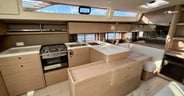
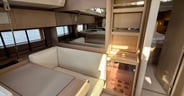
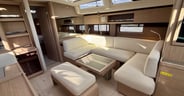
The companionway is elongated so the stairs are a gentle descent with handrails on both sides. I was struck by how much this broad space resembled a cozy open-concept apartment rather than a cramped boat salon. My attention was immediately drawn to a couple of features.

First was the aft-facing navigation desk in the port forward corner. It is just behind a mirror that helps brighten the space and makes it seem larger. The downside of the desk is that it’s right by the galley, so a small Lexan splash screen would help. The wide seat makes a comfortable home office or even a secure and tucked-in spot to read during a rough passage.
Inboard of this desk and just behind the compression post is sole-to-ceiling open storage. The top section forms a library for cruising guides, books, or decorations, and the bottom is designed for bottle and bar storage. It’s an unusual and thoughtful detail that draws the eye immediately.

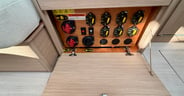
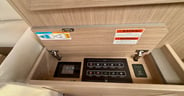
To starboard is the dinette with an electric high/low table that folds in and out and lowers to form a coffee table or a lounge with cushion inserts. Just aft is a cabinet that hides the DC panel and the digital switching screen, which displays information on batteries, tankage, and shore power. Below, battery switches and breakers are neatly organized and accessible.

Beneteau Oceanis 52 Galley
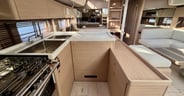
The U-shaped galley is to port. Its cozy layout allows passengers to cook and wash up even while the boat is heeling underway. Corian countertops with fiddles are a nice upgrade and the additional storage on the inboard side of the island is exceptional.

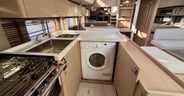
The rest of the galley includes a standup refrigerator and freezer, a gimballed three-burner stove, a microwave, a 60/40 split sink, and an optional washer/dryer below the countertop. A cabin sole hatch provides access to the tank manifolds so you can easily switch between the three water tanks without tearing apart the furniture.

Cabins
Two guest cabins are aft. The one on starboard has direct access to the large single head. This is the only arrangement available in the owner’s version, but it would be useful for cruisers to be able to convert the port cabin to a storage room or workshop.
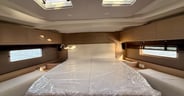
The main cabin is forward and includes a large island bed, twin overhead hatches, and a split head with the toilet to port and a large shower to starboard. This cabin is generously proportioned with seats on either side of the bed, a hanging locker, and a small vanity.

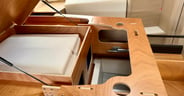
Storage below the bed that can be accessed with the help of gas shocks.

In the charter version, this space can accommodate two cabins and two wet heads. Also for charter, the galley moves forward and usurps the space otherwise allocated to the nav station. The head moves to port and an over/under bunk cabin is shoehorned in on starboard. This loses some of the charm of the owner’s version but it does the job of accommodating 10 charter guests.
The finishes have been upgraded from the .1 series. Upholstery has gone upmarket, direct and indirect lighting is everywhere, and the headboard in the primary cabin is a textured wood finish that adds the kind of detail people remember.
Beneteau Oceanis 52 Performance
The Beneteau Oceanis 52 is slippery and moves easily in a light breeze but also digs in and feels stable when the wind pipes up. Captains have a choice of a self-tacking jib or an overlapping genoa for better performance. The deck-stepped mast can also carry a 1,539-square-foot Code 0 that adds versatility and lots of power. Below the waterline, you can choose a 7-foot, 9-inch T-shaped keel or a shoal version at just 6 feet, 4 inches. Twin rudders help grip when making way upwind and are necessary due to the near-16-foot beam.

Sail Performance
Test day on Chesapeake Bay served up varied conditions, from light following winds to decent beam breezes. The most impressive numbers I measured included making 7.4 knots of speed over ground in 11.4 knots of true wind at 60 degrees apparent wind angle. That’s 65 percent of wind speed, during which she stayed on her feet and answered the helm quickly and precisely.
Beneteau smartly improved line handling by giving the primary and secondary winches separation. The primaries are aft by the wheels and within reach of the skipper. You can opt to make them electric. The secondary winches are forward, ahead of the deck stairs. Crewmembers can lean over these winches and put their weight into grinding, or the helmsman can command them with electric buttons on the starboard pedestal.
All sailing can be done without disturbing the guests in the social part of the cockpit. The mainsheet is doubled and attached to the integrated arch over the companionway. There’s no trace of a traveler because Beneteau feels it is misunderstood by too many cruisers, so they choose to save money and eliminate it.
Power Performance
Under power, the 110 hp turbo Yanmar pushed us along at 7.7 knots at 2,300 rpm cruising speed. At wide open throttle, 3,150 rpm, the boat reached 8.9 knots. Beneteau chose to pair the diesel with a Saildrive rather than a straight shaft. I’m not sure that is ideal, but it works with the geometry of the boat. Fuel tankage is light for a cruiser with only 53 gallons.
Cruising and Chartering
Beneteau is a workhorse in charter, so half of the hulls go into commercial service. That means you can test one at an exotic location and live with it for a week before making a purchase decision. The only downside is it won’t be the owner’s version.
The base price for the Beneteau Oceanis 52 is $720,000. As tested—Elegance package and air conditioning, generator, washer/dryer, cockpit galley—our owner’s version boat cost $994,000. That’s a significant investment but is 7 percent less than the 51.1, according to Beneteau.
The Oceanis 52 is one of those boats whose brochure cannot do it justice. You must sail her to truly appreciate her. The changes and upgrades Beneteau made have elevated her well beyond her predecessor and even beyond this tester’s expectations.
Beneteau Boats For Sale


Zuzana Prochazka
You might also like


