How and Why to Cruise Channel Islands National Park

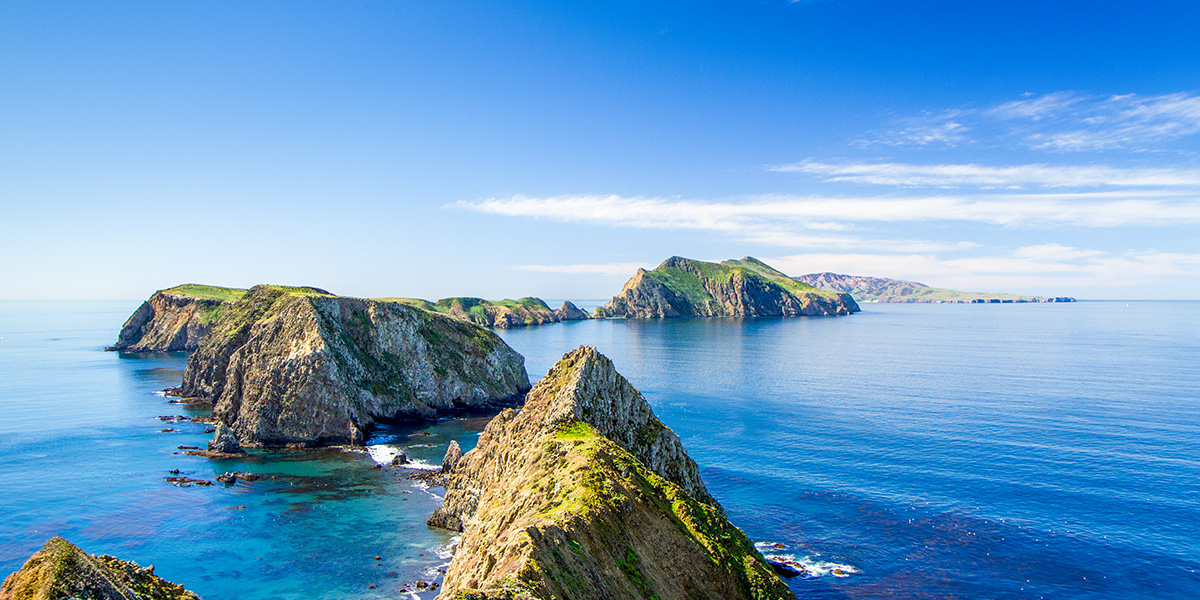


Beyond Southern California’s much-cruised coast, Channel Islands National Park is one of the country’s most overlooked natural treasures.
Teeming with marine wildlife, the closest of the park’s five islands is an hour offshore via boat yet feels a world away. Do you enjoy whale watching? How about kayaking? Or perhaps snorkeling is your activity of choice? The Channel Islands offer something for most outdoor enthusiasts.
A National Park at Sea
Once home to Chumash villages, a bombing range, and even a spring training site for the Chicago Cubs, the Channel Islands have a rich and unique history. Eight islands loom off the California coast, but only five of them comprise Channel Islands National Park.
Designated a federal park by President Jimmy Carter in 1980, Channel Islands National Park encompasses Anacapa, Santa Cruz, Santa Rosa, San Miguel, and Santa Barbara islands. The islands sit within the 1,400-square-mile Channel Islands National Marine Sanctuary, one of the world’s most diverse marine environments.

Rugged and rocky, the Channel Islands mirror the California coastline. Visitors are more likely to see an island fox or a bald eagle on a trip to an island than another human. The park ranks among the least visited of U.S. national parks because it is only accessible by boat or plane.
Reaching the islands by private boat requires some effort. Once you are there, though, it’s easy to see the comparisons to the Galápagos Islands.
Access and Anchorage in Channel Islands National Park
The fastest way to reach the Channel Islands by boat is from Oxnard or Ventura, about an hour north of Los Angeles. Expect challenging seas while crossing the channel, with afternoon windswept swells and occasional marine fog.
The trip is well-suited for boats with a deep-V hull. Boats with a low freeboard are discouraged because of the swells and the open ocean. Island Packers, the park’s longtime concessionaire, runs a catamaran to the islands.
It’s worth noting that personal watercraft are banned from the park.
“I recommend reading up on the channel and the weather, because it’s a nasty channel,” said Captain Doug Pflaumer, owner of Channel Island Tours. “It can turn very quickly, so you’ve got to pick your weather.”
No public docks are available, and the shoreline is rocky, so boaters must anchor and take a dinghy to shore. Boat owners can land on all five islands, but anchoring is only permitted in designated coves or safety zones. Nautical charts show the anchorages, and no permit is required.

Premier Saltwater Fishing
The Channel Islands are considered one of California’s premier saltwater fishing destinations. Surrounded by a vast marine sanctuary, the islands have a thriving fishery and kelp forests.
White seabass, lingcod, yellowtail, halibut, and rockfish abound. In the right season, anglers can even catch swordfish or tuna. The fishing areas are limited but clearly marked on nautical charts.
“Some years the white seabass is wide open when you’re fishing and it’s a great season,” Pflaumer said. “Another year, it’s the yellowtail. One year we had striped marlin off the back of Santa Cruz Island because of El Nino.”
Anglers are required to possess a valid California state fishing license and Pflaumer encourages everyone to read up on the regulations. California Department of Fish and Wildlife wardens actively enforce regulations, so be mindful of species limits and where to drop a line.
Exploring the Ocean
The number of boats within the national park is pretty limited, so you have an opportunity to explore the water in peace. In addition to fishing, the Channel Islands are renowned for diving. Divers will find vibrant kelp forests, rocky reefs, caves, and historic wrecks.
In the kelp forests, divers frequently encounter playful sea lions and even giant sea bass. Pflaumer said divers should have an open-water certification to scuba dive. Snorkeling is a great option for people who are not scuba certified.
“I would suggest going out with a dive boat that has a dive master on the boat the first couple of times until you learn the area,” Pflaumer said.
Kayaking is popular on Anacapa and Santa Cruz islands because of their well-known sea caves. Santa Cruz, the most popular of the islands for day hikes and overnight camping, features Painted Cave. The quarter-mile-long cave has beautiful lichen- and algae-stained walls.

Anacapa offers more caves, tunnels, and arches, but its strong currents make it challenging even for experienced kayakers. The Pacific Ocean can be chilly, especially when the wind kicks up, so paddlers need thermal protection.
When to Visit Channel Islands National Park
Locals say the best time to visit the Channel Islands is in September or early October. The weather is delightful, the ocean temperatures are warmer, and the tourists have left for the summer.
Most visitors go day hiking, but overnight camping is offered. Santa Cruz is the most popular island for camping; a reservation is required. Accommodations on the island are basic: no running water and composting toilets.
Tourists who need a hotel or a vacation rental can stay on Catalina Island, which is not part of Channel Islands National Park. Catalina Island, the one-time spring training home of the Chicago Cubs, has about 4,000 residents.
Visiting Channel Islands National Park is about returning to nature and getting away from the hustle of the mainland. Super pods of dolphins—anywhere from 1,000 to 5,000 dolphins—are a regular sight. November through March is prime whale-watching season as humpback whales and other species migrate.
“It is an incredibly nutrient-rich environment that’s always changing,” Pflaumer said. “It’s a real precious resource that everyone should see.”
Gregg Mansfield
You might also like


