About That Time We Had to Get Our MacGyver On

I grew up listening to stories of close encounters on the Chesapeake Bay. My father and grandfather told their stories with wide-eyed intensity. Close calls. Unexpected weather. Needing to make fast-acting repairs. As a kid, I listened with rapt enthusiasm. I never imagined I would one day share stories of my own.
Shortly after my husband, Adam, and I acquired our first sailboat, I shared our plans to move it from Washington, D.C., to Norfolk, Virginia, with my family during a dinner gathering. My uncle, who grew up on the Chesapeake, was usually quiet at family gatherings. Not this time.
He fixed me with a laser-like stare.
“You aren’t ready for the Chesapeake,” he said.
I brushed it off with the arrogant confidence of a novice sailor, but the ghost of his words nibbled at my conscience. My uncle never wasted his breath, and as much as I wanted to deny it, there was truth in what he said.
Old Boats
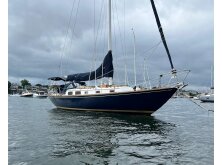
The boat was a gift from my father. He won the 1981 Newport 28 in a bet, sort of. A friend gave it to him to settle an old debt. My father was well past his sailing prime, so he gave it to me. Free, unwanted boats are never actually free. You will have to pay for it one way or another. For us, we paid in blood, sweat, and tears.
We discovered immediately that we couldn’t afford to keep her in her D.C. It was a mad dash to get her south, into less expensive water. But every time we tried to move her, something broke. The engine was always in disrepair. Clouds of white smoke continuously trailed behind our stern in a telltale wake. We had to replace the head. The holding tanks were leaking (eww..). The steering cable snapped. We needed to reinforce the chain plates and replace the faulty depthfinder. The through-hulls were stuck. And the list continued…
Finally On Our Way
Bit by bit, we fixed our broken boat. If this boat taught us anything about sailing, it was that making fast-acting repairs under immense pressure is 75 percent of the sport. When something breaks at home, you can take your time fixing it or call the plumber or electrician to fix it for you. On the boat, not only do you have to fix it yourself, but you have to fix it quickly, before she sinks.
After years of repairs, we were finally ready to head south. We fixed everything on the boat, or so we thought.
Delusions of Calm
Sailing downwind is called gentleman’s sailing for good reason. It’s like an organized symphony compared to the broken carnival ride of beating upwind.
As we cruised down the Chesapeake, the wind was at our back, pushing us along lazily with both our sails full. We were wing on wing, a beautiful sight, with our oversized candy cane–striped jib. Sailing faster than 8 knots, we were breaking personal records. Our speed increased, and we started to feel the wind building behind us. We didn’t anticipate needing to make any fast-acting repairs in short order.
Our rule was to put a reef in the sail when the wind increased past a certain point. We had to turn into the wind to lower the main and put a reef in. As we turned toward the wind, we started furling in the jib.
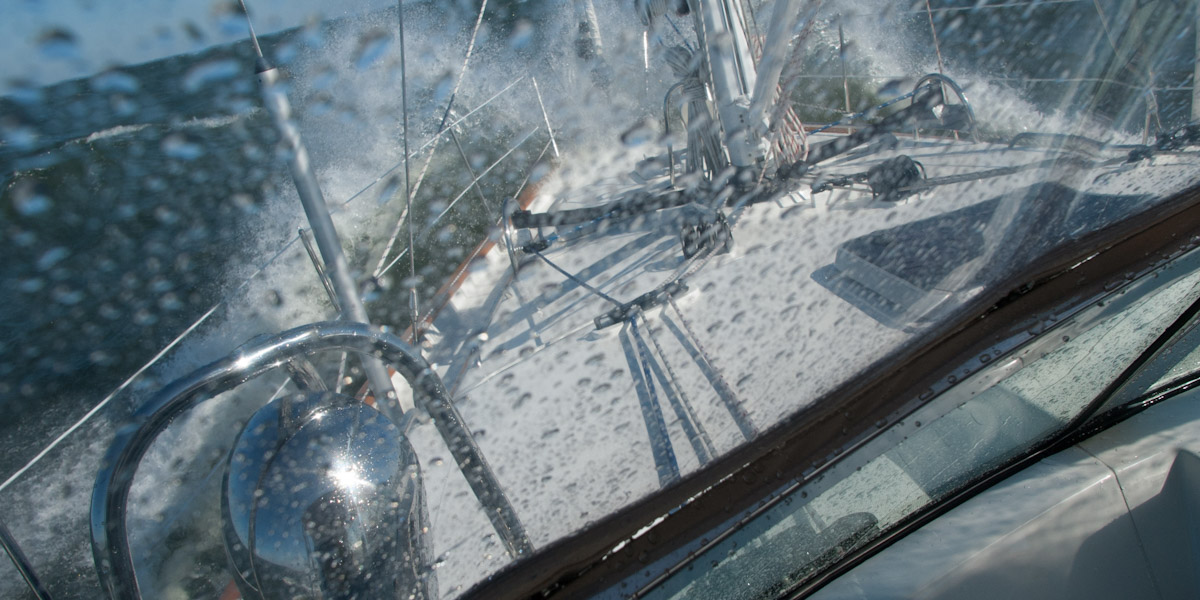
Turning upwind felt like heading into a gale. The wind howled and waves crashed on the bow. Almost immediately our leech line wrapped itself around the spreader about 15 times. We couldn’t furl the jib in at all. Our pitiful engine was at full throttle, but I couldn’t get any steerage with the jib stuck on the spreader. We could barely hear each other over the chaos.
Adam kept yelling at me to turn the boat, and I kept screaming back at him, “I’m hard over!”
It’s amazing how quickly things can go wrong on the water. One minute we were sailing downwind on the bay and losing ourselves in bright conversation on a perfect day. The next, we were in a crisis that had me shaking all over and vowing never to get on the boat again. Fast-acting repairs were needed now.
Fast-Acting Repairs and Problem-Solving
There we were, stuck with our nose close hauled and our jib full of wind. Little did we know that the leech lines had been slowly separating themselves like a loose thread over the course of weeks.
While I stood behind the useless wheel, our boat sailed itself toward shallow waters, pound nets, and a minefield of crab pots.
It was time for fast-acting repairs.
Without wasting a moment, Adam grabbed our heavy-duty telescoping boat hook. He fully extended it to 15 feet and duct taped a knife to the end. The tangled leech lines were about three-quarters of the way up our jib, very much secured around the spreader. It must have been 20 feet above the deck.
Lying on his back while the boat rocked and rolled on steeply stacked waves, Adam struggled to aim the knife at the leech line tangle. For a few intense minutes, he swore intermittently and I held my breath. Finally, he sawed through the leech line. I still don’t know how he managed to do it without slicing the sail.
After we cut ourselves loose, we turned back downwind and continued our journey south. We quickly realized why so many sailors have their sails and rigging inspected on a newly acquired boat.
Chesapeake Bay Shipwrecks
Looking back on my father’s stories of the Chesapeake, I can understand how the bay had him and my grandfather praying for their lives. The body of water itself is immense, the largest estuary in the U.S. But it can be treacherous.
The shallow depths and tidal flow generate steep and tightly packed waves. Wind against tide or severe thunderstorms can turn the pot to boil in an instant. But don’t take my word for it. One map of Chesapeake Bay shipwrecks pinpoints more than 1,800 wrecks peppered along the bottom of Chesapeake Bay.
Confidence With Fast-Acting Repairs
Confidence is a funny thing on the water. You need it to be a boater, but you can’t have too much of it if you want to be a good boater.
I will admit that a heavy dose of reckless courage helped turn our sailing dreams into reality. But it didn’t take long for the Chesapeake to chip away at our ‘recklessness’ and replace it with newfound patience, humility, an ability to perform fast-acting repairs, and rapid-fire problem-solving.
Find Your Next Sailboat in the Marketplace


Olivia de Soria
You might also like


