A Near Collision at Sea: Our Encounter with a Container Ship

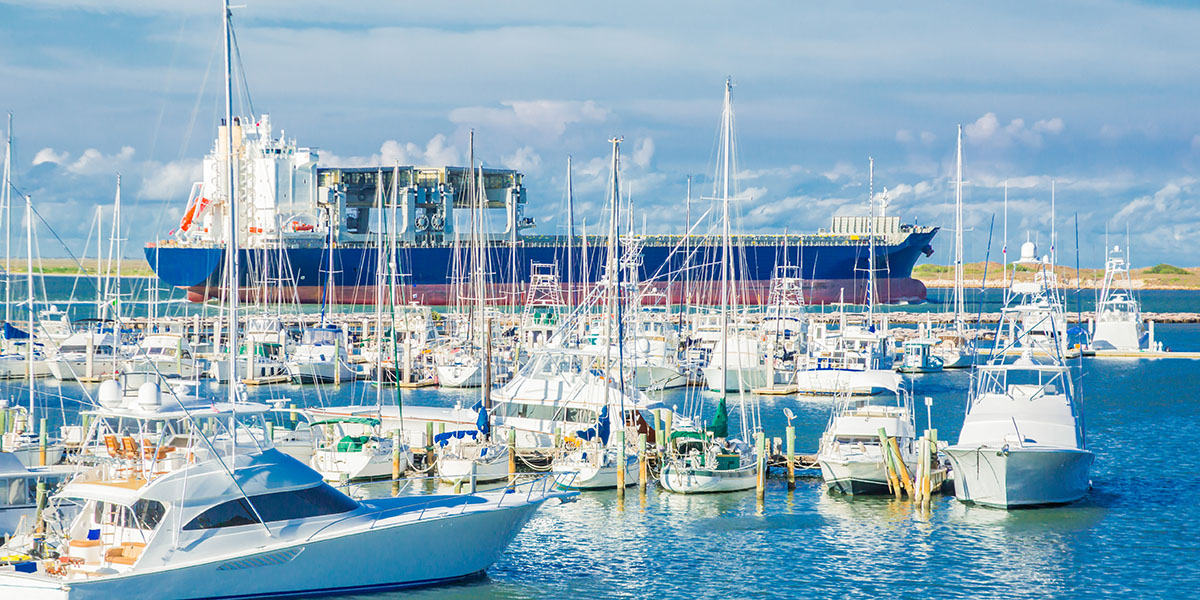
The open ocean brings to mind a vast empty landscape of deep blue. You would think there is more than enough room for everyone to share, that you would never have to worry about a collision at sea. But reality often tells a different tale.
The sea is the most popular means of international transport. Like it or not, your open-ocean adventure will probably cross the paths of many oceanic leviathans. Some of these vessels are as long as skyscrapers are tall. If they hit you, there’s a good chance they won’t even notice.
Of all the dangers sailors face at sea, giant ships are among the most common and serious. Allow me to share our encounter—a near collision at sea—with a container ship in the Gulf of Mexico. There are plenty of takeaways from the story that make it worth telling.
Our First Crossing
A few years ago, my husband and I and two children sailed to Mexico from Florida with two friends on their 40-foot Leopard catamaran. This journey was to be our first crossing, and we were delighted to be invited by friends who could impart some expertise and share the experience with us.
Being in the open ocean for the first time is thrilling. As the land disappeared on all sides, we suddenly became very, very small. And when night fell, that feeling was only elevated. About two evenings into our journey, my husband, Adam, was on watch under a blanket of stars. In the wee hours of the morning Adam spotted a boat. Lights materialized on the northern horizon, dimly lit against the surface of the ocean. He kept his eye on it and his attention fixed.
As other ships’ lights meandered about the horizon, this particular light stayed fixed in one spot and was beginning to raise hairs. Instead of a red or a green, we saw only two deck lights.
A few minutes passed and the light continued to grow. Adam started to worry. We were on a true sailboat, basically motorless, which is pretty rare today. This 40-foot cat was an anomaly, with solar-powered engines only intended for docking the boat. You could say the owners were pretty hardcore. We, at this young and inexperienced part of our sailing career, were not.
A Growing Concern
The light on the horizon was only getting bigger, but it was still absent of a red or green indicator. We could not determine its course. Suddenly, the eerie black silhouette of a gigantic ship appeared. A terrifying shape darker than the night sky and as big as a skyscraper was upon us.
My husband realized that the ship was in fact headed straight for us. Hence, why we could not see the red and green lights.
Obviously, this is when we prepared to change course, right? Wrong. The wind was too light. We had very little steerage. Definitely not enough to change course.
Without a motor, we had no way to change direction.
A Near Collision at Sea
Finally, the Automatic Identification System (AIS) alarm sounded. But it was far too late to do us any good. Adam could feel the vibration of the ship’s motors as they powered this massive piece of machinery at 16 knots.
Our friends were awake at this point, and everyone was running around the boat trying to figure out what to do. The ship’s name popped up on the AIS, and Adam called it again and again without a response.
Finally, a green light materialized as the boat turned hard to port to avoid a collision. The enormity of the ship really sank in as she showed us her full length. It was so close we could smell the diesel from the engines. We felt the vibrations as she passed about 150 feet behind us.
Holy s***. That was close.
Why Are So Many Boats on the Same Course?
Most boaters use a GPS navigation station that pulls data from a similar source. Plug in your destination on the navigation device and the suggested course will be standard. You can bet that a number of other captains are on the same trajectory.
Depending on where you are going and what the current and wind conditions are, consider putting your course in manually, just off center of the one your GPS generated for you. This will take you slightly off the main path.
Shipping Channels
Are you plotting a course in blue water? Check your charts to see if it crosses a shipping channel. If possible, steer your course a little one way or the other to avoid being dead center of it.
Make sure your AIS is set up correctly with a large field of view, like 10 miles. Also, keep someone on watch at all times.
AIS and Marine Radar to Avoid a Collision at Sea
Since that harrowing night, my husband and I have done our fair share of ocean sailing on our own catamaran. We understand one avoidable error from that night in the Gulf of Mexico. Our friends had recently installed their AIS and the radius for the alarm was way too small. It was there more as an afterthought versus a preventative tool.
If you have AIS on your boat, set it up to be useful to you and your crew. AIS models feature many different modes and functions. Make sure you understand yours.
A recent AIS development is truly revolutionary. On our boat we use AIS in combination with marine radar. We can see another boat miles away and know its speed, course, and vessel length. With that information on a large radius, we are alerted of a potential collision at sea nearly an hour ahead of time. We can make slow and small adjustments to our heading on the autopilot to steer clear of any disaster.
Know How to Read Navigation Lights
Sailing at night can be somewhat discombobulating. If you don’t have much experience deciphering red and green lights in the black of night, give yourself a refresher on navigation lights.
Collision at Sea Is a Real Threat
Unlike many sensationalized dangers associated with sailing, this one is a real danger that many will face. My husband and I bring up this story in the sailing community regularly. The response? Many stories from sailors highlighting their near collision at sea. Almost everybody in any room full of sailors has one.
The ocean is full of large vessels and cruise ships transporting consumer goods and people. If you are prepared and informed with a properly installed AIS and a good eye for navigation lights, you will maintain your journey’s safety and keep your memories bright.
Olivia de Soria
You might also like


