5 Towed Watersports Hot Spots Across the U.S.

Through my decades of competing in and coaching towed watersports and working on advertising campaigns, I’ve been fortunate to visit many of the most beautiful lakes and rivers across the United States. I have been to many towed watersports hot spots.
Each watersport—whether skiing, wakeboarding, or wakesurfing—has its own nuances and personality when it comes to having fun behind the boat. Yet they all share one essential need, and that’s water. Fans of these activities look for the same thing: smooth water, and plenty of it.
Based on my experience, I’ve selected five of my favorite towed watersports hot spots from different regions of the country. These locations offer excellent conditions for all towed sports, though some are better suited to specific disciplines. But there’s more to these places than just the water.
Each hot spot is set in a naturally stunning landscape that gives it a distinct personality, enhancing the overall enjoyment of our favorite sport. Let’s take a journey across the country and discover why each one offers not only great conditions but also an unforgettable experience.
Eastern Region: Squam Lake, New Hampshire
Towed Watersports on Golden Pond

Squam Lake is a beautiful body of water located in central New Hampshire’s Lakes Region, just north of Lake Winnipesaukee. It’s full of islands and coves that make it beautiful and provide an ample variety of waterways for boating and watersports.
Stretching about seven miles in length, Squam Lake has a maximum depth of roughly 100 feet, with an average depth of about 36 feet. The water is clear and pristine, surrounded by pine forests and framed by the White Mountains in the distance. Squam is considerably smaller than neighboring Lake Winnipesaukee, which makes it a quieter lake, adding to its New England charm.
It’s no wonder the 1981 film “On Golden Pond,” starring Henry Fonda and Katharine Hepburn, was shot on Squam Lake. Its natural setting and crystal-clear water make it an ideal location for all types of tow sports—and a truly memorable experience.
When to Go and What to Do
May through September are the best months for towed watersports here. I recommend you wear a wetsuit in May and September. The prime months are June, July, and August, when the water warms into the mid-70s.
Anyone can bring a boat to Squam Lake, as there is a public launch ramp. Most boats on the lake are 25 feet and smaller. Squam has a speed limit during the daytime of 40 mph, but that’s enough speed to do all the tow sports, even barefoot skiing.
Locals are protective of the shoreline and nesting loons in the coves, so stay at least 200 feet from shore and other boaters—and even farther when wakesurfing. The middle of the lake offers deeper water, which is better for wakesurfing and helps preserve the peaceful shoreline environment.
Do you not have your own boat? Would you like to take lessons? New Hampshire Watersports offers tow sport charters with a coach and all the necessary equipment. They use an Axis wake boat and provide instruction in wakesurfing, wakeboarding, and waterskiing. They also offer tube rides.
Squam Lake offers a variety of lodging options and lakefront restaurants. Walter’s Basin is a favorite, serving New England favorites such as sweet, succulent lobster rolls and hearty chowder while giving diners a stunning view of the lake.
Squam Lake is a must-visit destination for tow sports enthusiasts looking to enjoy their sport in a breathtaking New England setting.
Midwest Region: Minocqua Chain of Lakes, Wisconsin
Towed Watersports Heaven

Located deep in the lake region of north-central Wisconsin, the Minocqua Chain of Lakes is surrounded by pine trees and cottages, making it a charming summer resort destination. Minocqua is the anchor lake, with canals connecting to Tomahawk, Kawaguesaga, and several smaller lakes. The interconnectedness creates an abundance of waterways for watersports and boating.
It’s an idyllic destination for families who love watersports. Minocqua has a long-standing tradition in waterskiing and tow sports. The 1952 USA Water Ski National Championship was held here.
Several launch ramps make the lakes accessible for out-of-town boaters. The maximum depth is about 60 feet, with an average depth of 23 feet. Most boats on the Minocqua Chain are 25 feet or smaller, and many pontoons cruise slowly through the scenic waterways.
When participating in towed watersports, especially wakesurfing, stay at least 200 feet from shorelines, docks, other boaters, and anyone using the water.
When to Go and What to Do
The towed watersports season runs from May through September. You will find prime conditions in June, July, and August when the air and water are consistently warmer. In early June, water temperatures may still be in the 60s, so you will want to wear a wetsuit.
If you want to learn how to wakesurf or master a new trick, Surf SCONSIN offers lessons in Minocqua. They use a specialized MasterCraft wakesurf boat and provide a flotation vest and a Connelly wakesurf board with each lesson.
When you’re not skiing, wakeboarding, or surfing, catch the Min-Aqua Bats waterski show—a local favorite. The Min-Aqua Bats is the longest-running waterski show in the country. They perform at the Aqua Bowl three times a week: Wednesday, Friday, and Sunday at 7 p.m., from mid-June through the end of August. There’s no charge to watch the show, though donations are welcome.
After the show, head to the Thirsty Whale, a popular waterfront restaurant where the Friday Fish Fry—perch and walleye—is a northern Wisconsin tradition. And don’t miss the local shops in Minocqua that offer homemade fudge.
If you’re into towed watersports, Minocqua in the summertime will leave you with lasting memories of fun, natural beauty, and northern Wisconsin charm.
Southeast Region: Butler Chain of Lakes, Orlando, Florida
The Mecca of Towed Watersports Hot Spots
With Disney, Universal, and SeaWorld all local, Orlando is the theme park capital of the world. But it’s also a mecca for watersports thanks to an abundance of lakes and year-round warm weather. If you wonder why this might be among the best of the towed watersports hot spots, you should know that Orlando is where towed watersports pros from around the world come to train and coach.
Of the many lakes in Orlando, the Butler Chain—they span from Orlando to neighboring Windermere—offers more than 5,000 acres of interconnected waterways perfect for tow sports. The chain includes 13 lakes, with Lake Butler being the largest.
The Butler Chain averages 10 to 20 feet in depth, with some areas reaching 30 feet. Cypress and oak trees line the shores, giving the lakes a classic Florida charm that makes every photo look like a postcard.
The sandy bottom and shoreline, along with shallow banks, help dissipate boat wakes and minimize backwash. This creates flatter, smoother conditions ideal for tow sports. A 40-mph daytime speed limit helps maintain safe and consistent conditions. Several public boat ramps are available for non-residents.
When to Go and What to Do
While the climate allows for year-round watersports, cold fronts do pass through central Florida during the winter. Water temperatures can drop into the 60s or even the upper 50s. I recommend a wetsuit for winter sessions.
The Orlando area is rich with towed sports schools and coaching options, including programs that offer high-level instruction in specific disciplines. Florida Ski School, located on the Butler Chain, provides lessons for all skill levels—including beginners—and even offers instruction in the newest watersport, wake foiling.
If you need new gear, nearby shops feature pro shops stocked with the latest tow sports equipment.
Also nearby is OWC (Orlando Watersports Complex), which features a cable park for a boat-free wakeboarding and waterskiing experience. OWC also offers lessons for both cable and boat-based watersports.
For year-round watersports action—paired with visits to world-renowned theme parks—the Butler Chain of Lakes definitely deserves a spot on your agenda.
Western Region: Lake Powell, Arizona/Utah
A Lake in a Desert
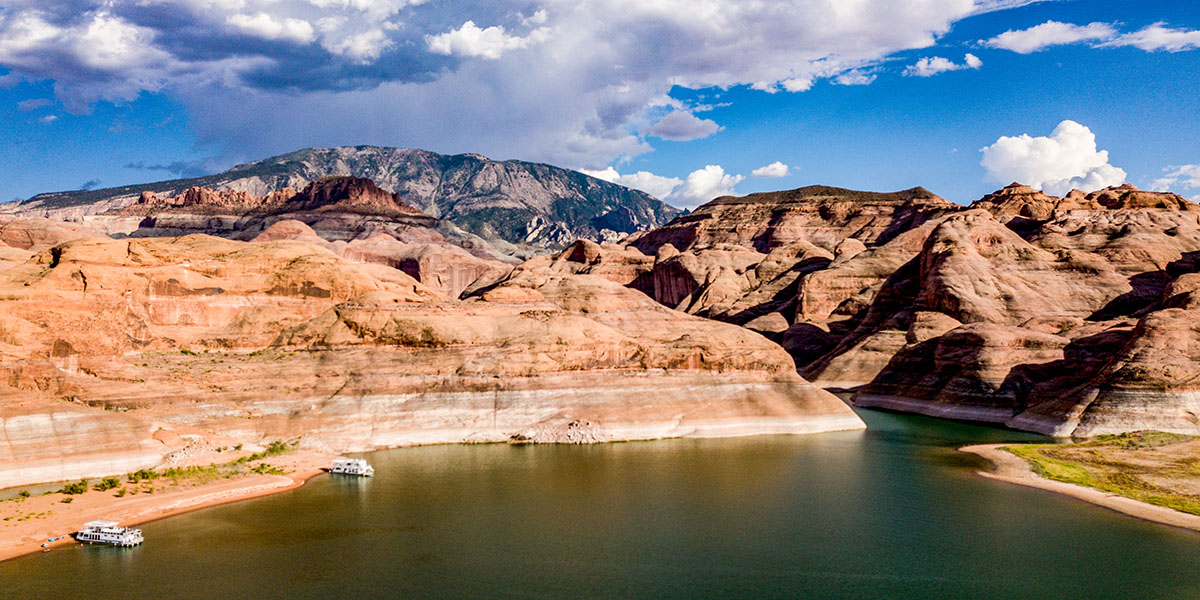
Lake Powell is so massive that its 186-mile length stretches from northern Arizona into southern Utah. With an abundance of coves and canyons, it boasts 1,900 miles of shoreline. Except for a few marinas, Lake Powell is free of human-created structures or homes. That makes it one of the most remote towed watersports hot spots and a perfect location for endless tow sports, especially wakeboarding and wakesurfing.
The lake was created in 1963 with the completion of the Glen Canyon Dam in Arizona. Nestled in the high desert, surrounded by reddish cliffs, canyons, and mesas, Lake Powell offers an otherworldly setting that can make you feel like you’re boating on Mars. It’s no wonder Lake Powell has been used as a film location, such as for the 1969 movie Planet of the Apes.
The deepest part of the lake is near Glen Canyon Dam, where it reaches nearly 600 feet when full. Across most of the lake, the average depth is about 130 feet. Depending on snowmelt, rainfall, and inflow from the Colorado River, Lake Powell’s depth can fluctuate by as much as 30 to 50 feet, which can affect boat ramp access. Knowing the lake’s depth is important to avoid areas with submerged rocks that could damage your propeller.
When to Go and What to Do
Technically, you can engage in watersports on Lake Powell year-round, but water temperatures dip into the 40s during the winter. The prime season is April through October. Air temperature ranges from the 70s to well over 100 degrees. The water will range from the mid-50s in April to near 80 degrees in July and August. September and October are especially ideal for watersports—fewer boaters and water temperatures still around 70 degrees.
Though there are motels in nearby towns like Page, Arizona, many visitors trailer their boats for day trips. Others rent or bring a houseboat, pairing it with a watersports boat for overnight adventures.
For a truly unique, out-of-this-world tow sports experience, Lake Powell is a must.
South Central Region: Brazos River, Texas
The Long and Winding River of Towed Watersports Hot Spots
As the saying goes, “Everything is bigger in Texas,” and that certainly applies to its waterways. At nearly 900 miles long, the Brazos River provides a warm-weather destination for towed watersports. However, not all of the Brazos is suitable for tow sports, especially in its shallower northwest sections. Yet, many hundreds of miles of the river and its dammed sections offer perfect conditions for all waresports disciplines.
Stretching from the Texas Panhandle all the way to the Gulf of Mexico, the Brazos is one of the longest rivers in the United States. Along its course, the Brazos winds through ranchlands, limestone cliffs, bluffs, sandy beaches, and fertile farmland. All of those contribute to this waterway’s unique character.
The Brazos River is set in an arid landscape, and even today, much of it remains wild and undeveloped, making it a place of raw natural beauty. Its untamed nature and history have been the inspiration for many books, songs, and poems.
But towed watersports enthusiasts love the Brazos for a different reason. Its sand and clay shoreline, with a gentle slope, absorbs boat wakes and creates smooth water conditions. It is ideal for slalom skiing, wakeboarding, and especially barefoot skiing.
Outside of the dammed reservoirs, the river is typically only several hundred feet wide, which promotes boats going in one direction rather than circling a lake. The winding river always provides a direction that shelters the water from the wind. This all adds up to calmer, smoother water, the kind of glass every watersports aficionado dreams about.
With so many long, uninterrupted stretches, it’s a training ground that feels almost endless. The Brazos has also hosted prominent competitions in wakeboarding, wakesurfing, and barefooting.
The Brazos has been dammed in several sections to form reservoirs, including Possum Kingdom Lake northwest of Fort Worth, Lake Granbury southwest of Fort Worth, and Lake Whitney southeast of Dallas. These dammed areas are much wider and deeper than the rest of the Brazos River.
Below Possum Kingdom Lake, the river begins to have areas that are deeper for tow sports, especially as it continues southeast to the Gulf of Mexico. In these areas, the Brazos River reaches 10 to 20 feet in depth, which is suitable for tow sports.
When to Go and What to Do
Because the Brazos is located in the south, you can use it for towed watersports year-round. You will, though, need a wetsuit or drysuit from November through March. The ideal months for tow sports on the Brazos are from April through October, when air temperature ranges from the 70s to the upper 90s.
Boaters have access to numerous public boat ramps along the navigable parts of the river and on its dammed sections. Conduct some research into the area you plan to visit to find the perfect safe spot with enough water depth for your specific activity.
The Brazos River, with its independent Texas character and the area’s distinctive cuisine—authentic Tex-Mex and legendary Texas barbecue, anyone?—will leave you wanting more. With all its twists and turns, the Brazos offers a Texas-sized adventure and abundant waterways for the ultimate towed watersports session.
Be Adventurous and Visit Towed Watersports Hot Spots
Whenever I travel to a new waterway, I approach it with a sense of adventure. I try not to prejudge the location but instead experience it both on the water and off. I wonder: What will the water conditions and temperatures be like? Will the surroundings inspire me? What new foods will I discover after a day on and behind the boat?
More often than not, I find each place is full of nuances that make the experience unique and memorable.
I’m fortunate to be with people who know the waterways, but it’s always important to do your research ahead of time. Ask locals about water depth, shifting sandbars, or hidden obstacles such as rocks or branches. Or find someone familiar with the area to go with you. This knowledge ensures your safety and provides a more rewarding and enjoyable adventure.
In the end, all of these towed watersports hot spots have their own personalities and surprises. Exploring them not only fuels your passion for the sport but also expands your horizons—on the water, and far beyond it.
Zenon Bilas
You might also like


