How Strong Is Your VHF Marine Radio Knowledge?

New boaters might wonder if it’s essential to have a VHF marine radio on board. And those who already have one might also wonder if there is a correct way to use it. The answer to both questions is yes — and here’s why.
Used by the U.S. Coast Guard, commercial vessels, recreational boaters, marinas, and bridge tenders, VHF is the standard marine communication system. The Coast Guard requires power-driven vessels longer than 65.6 feet (20 meters) and any boat or yacht cruising internationally to have a VHF radio on board.
Smaller recreational boats are not legally required to carry a VHF marine radio. Even so, it is considered essential safety gear, especially if you are headed offshore or to a remote cruising ground with poor cell reception. It’s your connection to bridges and marinas, your best bet for getting reliable weather updates, and your lifeline in an emergency.
We hope you did this in the lead-up to boating season, but if you need a refresher, read this to brush up on your VHF skills and etiquette. First, let’s answer a couple of questions. What type of VHF marine radio should you have on board? And what’s up with all those channels?
Handheld vs. Fixed-Mount VHF Marine Radio
Handheld VHF radios are compact and portable. They offer one to six watts of power and a roughly 3- to 5-mile range. Some models float and are waterproof, which makes them excellent choices for small watercraft and dinghies.

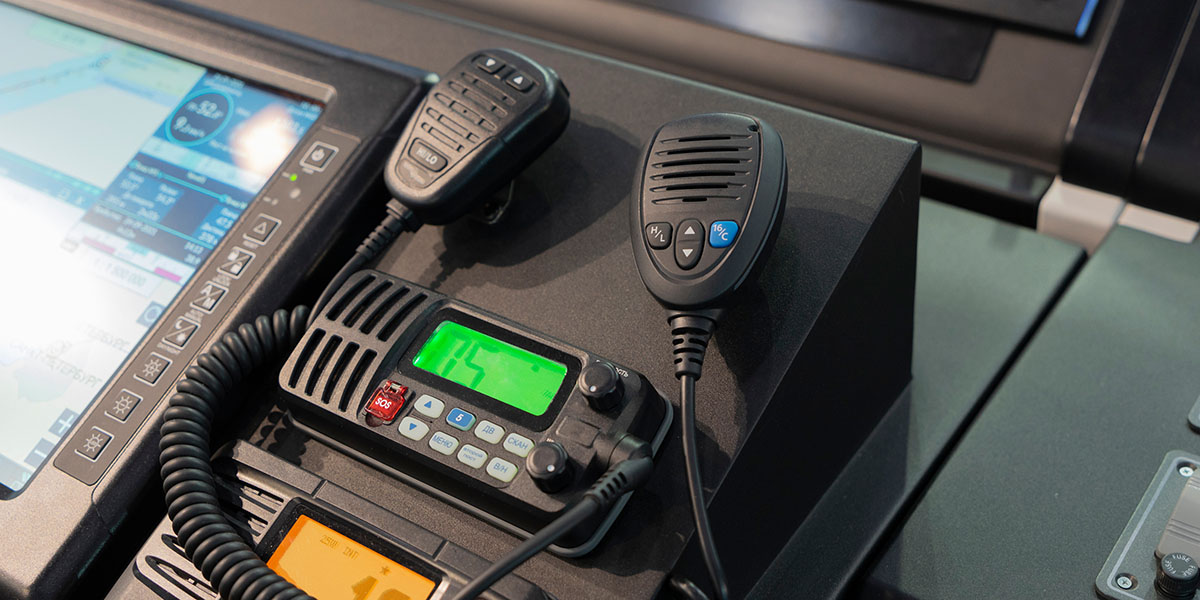
Fixed-mount VHF marine radios have greater power and range than their handheld counterparts: 25 watts and up to 25 miles. They are often integrated with GPS systems, and some might include Digital Selective Calling (DSC) for automated distress calls that provide a GPS location.
Handheld VHF radios make excellent backup systems. Consider carrying both fixed-mount and handheld radios aboard, just in case.
A Channel for Everything
You’ll quickly discover that your VHF marine radio has more than 20 usable channels. That might feel overwhelming. Don’t worry. Some channels are more important than others for recreational boaters. Here are the ones to know.
Channel 16 (156.8 MHz)
The Federal Communications Commission has designated channel 16 as the national distress, safety, and hailing frequency. It’s one channel the Coast Guard monitors around the clock. After making initial contact, immediately switch to another channel unless it is an emergency.
Note: Vessels with DSC will transmit automated distress alerts on Channel 70, which is reserved for that purpose. Voice communications should still begin on Channel 16.
Channel 9
Recreational boaters also have the option of hailing one another on Channel 9, which the FCC designated as a recreational calling channel to relieve congestion on 16. Just be aware that the Coast Guard does not monitor this channel for distress calls.
Channel 22
This is for urgent marine information and safety broadcasts such as weather warnings and navigational alerts. The Coast Guard also will use this as a working channel for extended conversations if necessary.
Channel 13
This is a navigation channel for 1 watt of transmission power only. It also is used for bridge-to-bridge communications. It comes in handy for learning about the traffic situation in close quarters, such as locks.
Channels 68, 69, 71, 72, 78A
These are working channels for noncommercial boater-to-boater communications. This is where VHF marine radio etiquette comes in. (See do’s and don’ts below.)
Channel W1-W4
These receive-only channels share weather broadcasts from the National Oceanic and Atmospheric Administration (NOAA).
Do’s and Don’ts of VHF Marine Radio Etiquette
Life on the water will definitely be easier if you know the do’s and don’ts of VHF marine radio etiquette. These are the do’s on the list:
- Remember the marine distress calls:
- Mayday is the emergency call for a life-threatening situation.
- Pan-Pan indicates the situation is urgent but not life-threatening
- Sécurité advises that you have a navigation- or weather-related alert to share.
- Keep a VHF channel guide at the helm for reference.
- Identify yourself by your boat name and your intended contact clearly, and use “over” when done speaking. For example: “Kids’ Inheritance, Kids’ Inheritance, this is Knot Working, over.”
- Listen before transmitting. And wait for confirmation before you speak again.
- Keep communications clear and brief.
- Move extended conversations to an agreed-upon channel. For example, channel 72 is a good choice for buddy boats traveling together.
- Say “out” when you’re finished with the conversation.
You don’t want to expose yourself as a newbie boater or a generally uninformed one, so keep these don’ts in mind:
- Don’t monopolize channel 16 with chatter. After you hail your intended recipient, move to a working channel for recreational boaters. (And don’t ever transmit a false distress call. It’s a federal offense.)
- Don’t use commercial or restricted channels.
- Don’t use VHF for private or lengthy casual conversations. Other boaters are listening and waiting their turn.
- Don’t use profanity or offensive slang.
- Don’t interrupt an ongoing conversation unless it’s urgent.
Be the boater who leads by example, and if you do need to offer guidance to someone who might not be following best practices, keep it friendly and respectful.
A VHF marine radio is more than just another piece of gear. It’s a vital tool for safety, navigation, and connection on the water. When we use it properly, we’re doing our part to keep our boating community safe and informed.
Additional VHF Marine Radio Resources
If you’re interested in learning more, BoatUS Foundation offers an online course that teaches students how to choose the right VHF radio and also how to use it.
For a hands-on, in-person experience, U.S. Power Squadrons, now rebranded as America’s Boating Club, provides comprehensive instruction.
Do you have a DSC-capable radio? Register for a free Maritime Mobile Service Identity (MMSI) number. The FCC and Coast Guard have authorized BoatUS to issue MMSI numbers for recreational vessels not required by law to carry a VHF radio. If your boat falls into the required category due to size or international travel, you need to register directly with the FCC.
Heather Steinberger