A Boat Safety Equipment Checklist for Another Season

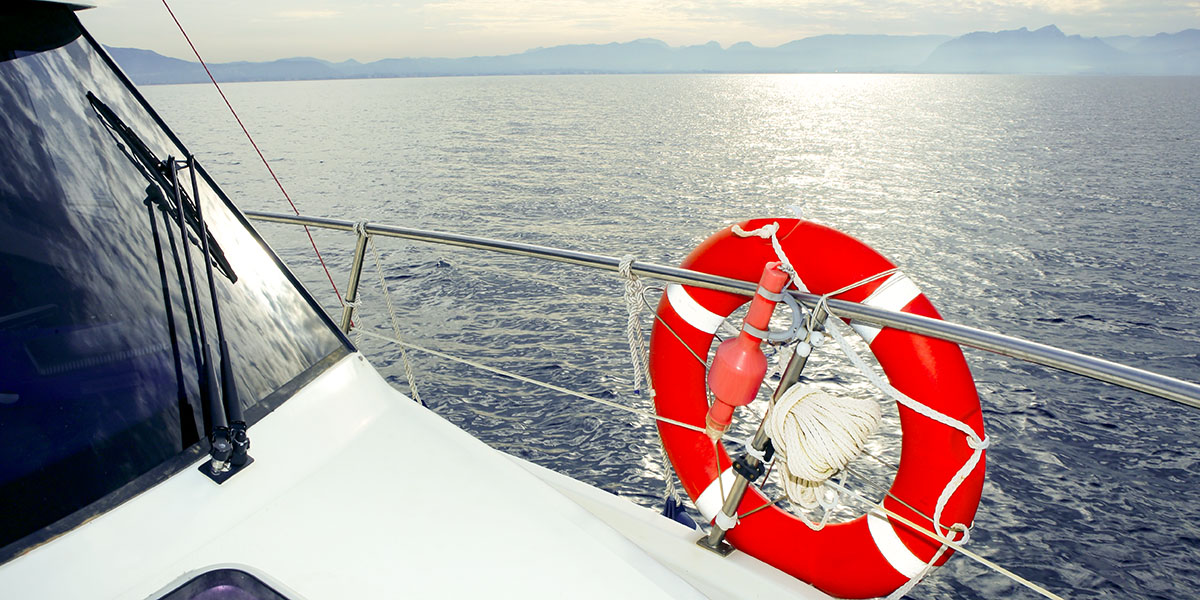
With the boat prepped for opening weekend and the summer, now is a good time to perform a safety check. If you have a routine for this, great. If you don’t—or maybe you’re looking for a more complete routine—we have a boat safety equipment checklist for you.
Required Safety Equipment
The U.S. Coast Guard requires recreational powerboats smaller than 65 feet to carry or have specific safety equipment. These items are required:
- Coast Guard-approved life jacket for each person
- Throwable flotation device
- An ABC (multiple-use) fire extinguisher
- Sound-producing device
- Navigation lights

If the boat has a sterndrive or inboard engine, the Coast Guard requires a ventilation system. Boat engines with a carburetor must have a flame arrestor. States may have additional requirements.
Not Necessary But…
A lot of boat owners go above and beyond what the Coast Guard requires. Ralph Bernard of New Jersey is one of those. Bernard, chief of the board of the United States Power Squadrons, a nonprofit organization promoting boating safety, courses, and skills, always carries the following on his boat:
- GPS/compass
- First aid kit
- Cellphone
- Toolkit
- Anchor with line
In his 46 years with the organization—300 of its squadrons nationwide offer low-cost boating courses and free safety checks—Bernard has heard plenty of boating mishap stories. They are reminders that, on the water, help can be far away.
“I know my wife is always screaming that I have too many tools,” said Bernard, who keeps socket sets, wrenches (standard and metric), screwdrivers, pliers, and duct tape in the toolkit. “All of a sudden when I need them, there’s never too many tools.”
Inspect Here First
Before he launches the boat for a summer of boating on Chesapeake Bay, Bernard checks the electrical system as part of his boat safety equipment checklist. He confirms the navigation lights are working and then turns his attention to the batteries and wiring. Bernard traces the wires from the battery to the engine and electronics. If he finds any fraying, he fixes it. He removes any corrosion on the terminals using a wire brush with the battery disconnected.
For older marine batteries, Bernard is always concerned with the amperage. You should check it regularly.
“The amperage is what’s going to turn that engine over,” he said. “You have to make sure you’re able to (start it), because you could be waiting a long time for TowBoatUS or Sea Tow. Especially on a busy summer day.”
Secondary Safety Inspections
Even if a boat has automatic bilge pumps, go into the bilge and manually test the pumps. When you need them most is not the time to find out they don’t work.
“Even though there may not be any water in there, I want to know that the bilge pump is working,” Bernard said.

While you’re in the engine compartment, check the fuel lines for any cracks. Outboard owners should do the same; the sun and heat can degrade fuel lines under the cowling.
Expiration Dates
Tucked away and forgotten under a hatch, fire extinguishers and first aid kits can easily expire before anyone notices. Inspecting them before the season should be part of any boat safety equipment checklist.
All boats should have an ABC dry chemical fire extinguisher, which can be used to tackle both fuel and electrical fires. Check the expiration date printed on the fire extinguisher. Any extinguisher older than 12 years should be replaced. Bernard shakes the fire extinguisher at the start of each boating season to mix up the contents.
“You can’t have too many fire extinguishers,” he said. “They don’t last very long if you’ve used one.”
Medications such as aspirin and antibiotic ointments can expire quickly, while glue on adhesive bandages can lose grip over time. Now is a good time to restock the first aid kit, especially if you used it frequently last season.
Easy Access
Safety equipment is no good if you can’t access it. Make sure the life jackets and a throwable flotation device are easily accessible as part of your boat safety equipment checklist. The same goes for the portable fire extinguisher. Store it near potential fire hazards where it will be accessible during an emergency.
When Bernard is taking new boaters out for the day, he gives them a short safety briefing that includes the locations of the floatation devices and fire extinguishers. New boaters want to help, but that can be a safety issue when arriving or leaving the docks. To avoid potential issues, Bernard briefs the crew on their roles. (He usually tells first-timers to stay seated.)
Bernard acknowledges that his briefings may make passengers uneasy. Even so, he wants the crew and safety equipment ready if an emergency arises.
“When something happens, people have a tendency to panic,” Bernard said. “Knowing where the safety equipment is and that it’s working is one less thing to worry about in an emergency.”
Gregg Mansfield
You might also like


