Let’s Get More Familiar With Boat Gunwales

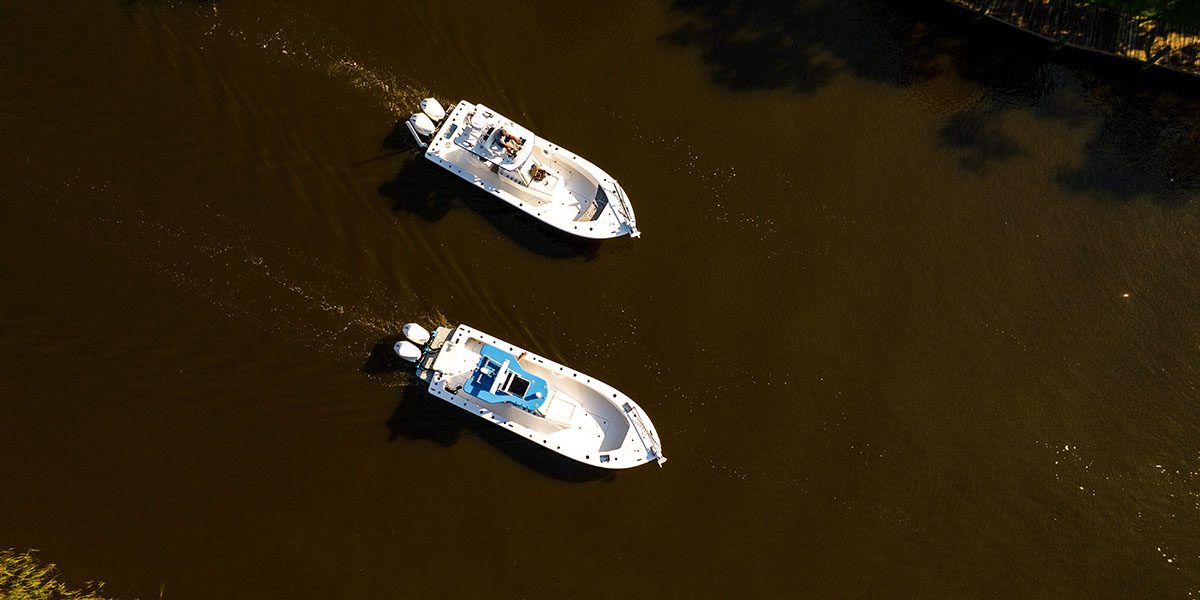
Name your favorite part of a boat. Is it the hull? The helm? The engines? Odds are, you didn’t pick the gunwale. This simple, often-overlooked part of a boat plays a big role. From keeping the hull stiff to keeping passengers safely in the cockpit, gunwales are unsung heroes of the boating world.
History Lesson
When ships ruled the seas with sails and gunpowder through the 17th century, wooden warships were reinforced to handle cannon recoil. Pronounced “gunnel,” the word “gunwale” comes from “gun” and “wale,” which meant “plank” five centuries ago.
Anyone who reads boating blogs or active in online forums has probably seen gunwale spelled “gunwhale” or even “gun wall.” It’s enough to make a copy editor say “Arr!”
What Are Gunwales?
The upper edge of a boat’s hull is the gunwale and it’s not just decorative. Yes, it is an attachment point for rod holders, cleats, and handrails, but the gunwale stiffens the boat’s structure.
“It’s basically the top cap,” said John Cosker, the owner of Mystic Powerboats. “If you look at a center console, it would be the top edge rail of what you walk around on.”
The width of gunwales differs by manufacturer. Cosker, who has a degree in naval architecture from Florida Institute of Technology, keeps them as narrow as possible on Mystic models.
“We’re trying to maximize the interior volume, which leads to challenges of structure,” Cosker said. “Because you have a thin element going vertically on the side of the boat, fitting bulkheads in there can get difficult.”
Which Boats Have Gunwales?
When Cosker designs a new boat, one of the first elements he focuses on is the gunwale.
“You basically start at the top of the hull,” said Cosker, who’s designed more than 40 boats. “Then you work from there inward. So the gunwale and deck are really the first design elements that we run through.”
Most monohull boats have gunwales. Catamarans may have elements of a gunwale for walking safely around the deck, but the feature is generally associated with V-bottoms.
Other boats have varying degrees of features that may be similar to gunwales:
- Skiffs and Jon boats feature a narrow or rolled edge to save weight.
- Center consoles boast a wide and sturdy gunwale for walking on and leaning against.
- Cruisers typically have higher gunwales to promote safety and style.
- Sailboats generally eschew a gunwale and keep a lower profile to avoid impeding the rigging.
- Pontoons run low and in flat water and don’t require structural gunwales.

Dive Doors
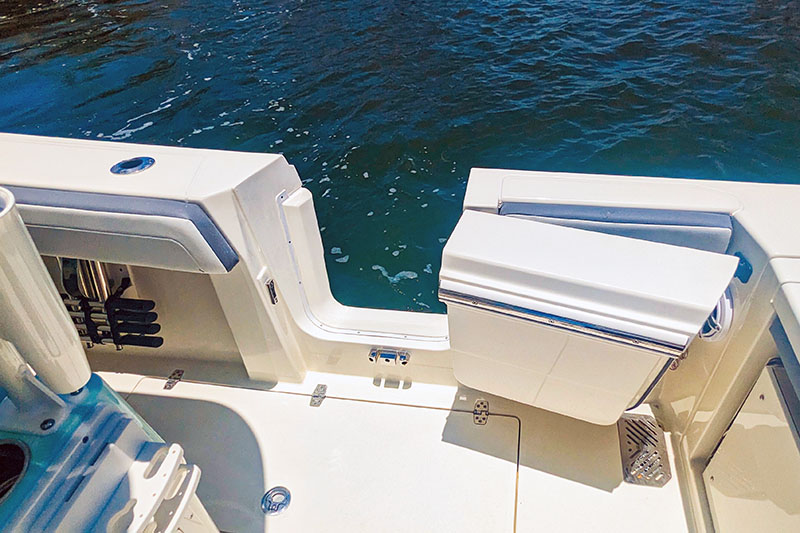
It might not seem like it, but dive doors and drop-down side terraces are marine engineering marvels. Removing the gunwale can affect the boat’s structural integrity, something boaters saw with the first generation of dive doors.
“Those (dive doors) weren’t terribly structurally sound because they weren’t part of the original design,” Cosker said. “They would cut into the hull and glass it up.”
Today’s boats get additional bracing to avoid cracking in the lower corner where the door weight was supported by a hinge. On Mystic’s 52-foot center console, Cosker eliminated the dive door and extended the swim platform for boarding.
“You can’t necessarily do that on a smaller boat,” he said.
Stepping Up
Gunwales house a variety of accessories. In fact, a cottage industry has sprouted up manufacturing products made specifically for gunwales. These include flush-mounted cleats, navigation lights, handrails, and more. The gunwale is some of the most valuable real estate on any boat.
Without a dive door or access via transom doors, people board and deboard the boat by stepping on the gunwale. To improve footing, a few builders would mold a diamond pattern into the gunwale. Not only was the diamond pattern rough on bare feet, it was difficult to keep clean.
Aftermarket companies then developed step plates with rubber inserts to provide better footing. The current evolution is marine matting, the same stuff used for the cockpit soles and swim platforms. Marine matting made by companies such as SeaDek or MarineMat is not only durable but soft on the feet while offering superior traction.
The handrails on the gunwale are for more than just hanging fenders off the boat. They provide a sturdy spot for holding on while riding in the bow.
A New Appreciation for Gunwales
The engines always attract attention. The hull gets the glory. And often, the gunwale gets overlooked by boaters. The gunwale is the ring (or glue) that holds it all together for a trip out on the water, whether you notice it or not.
Gregg Mansfield