Aquila 50 Yacht Review

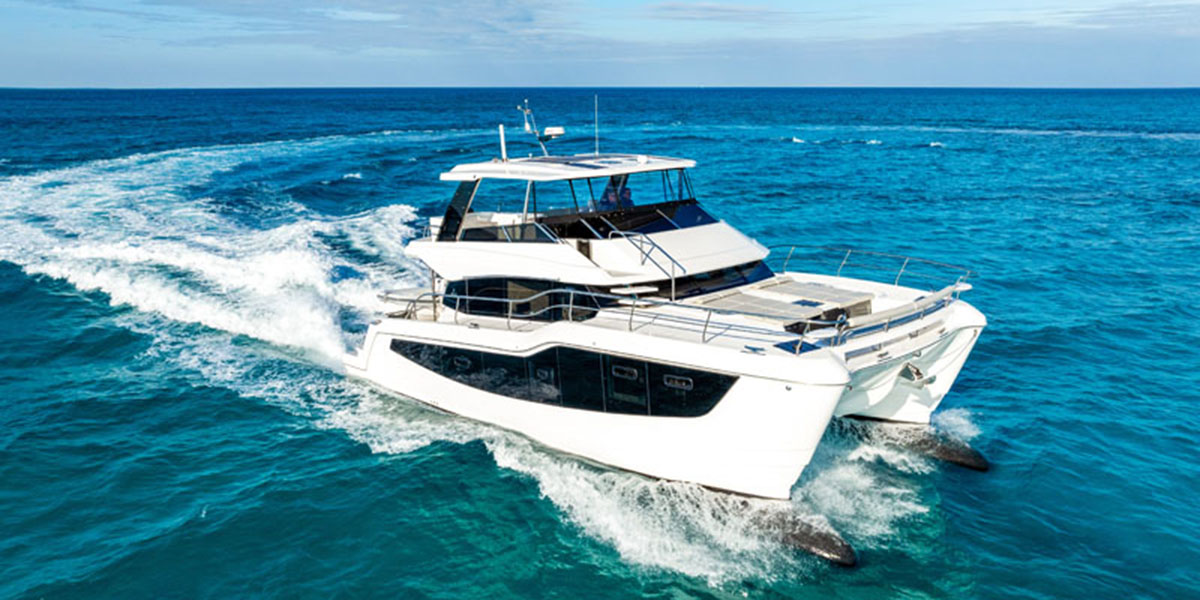

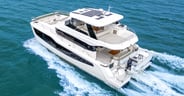

I don’t remember the first time an Aquila power catamaran caught my eye in an anchorage. I distinctly recall, however, that once I set foot aboard their 44-footer, I was planning life aboard. Right down to where I’d situate an onboard office. Power cats’ popularity has grown significantly since then, and Aquila offers models from 28 feet to 70 feet. The builder’s new Aquila 50 Yacht nestles comfortably into the middle of their “Yacht” line. It replaces the successful Aquila 48, so the Aquila 50 Yacht has big shoes to fill.
To signal its comprehensive cruising nature, Aquila has dubbed it an “Explorer Yacht.” Hull #1 debuted at the Fort Lauderdale International Boat Show last fall, and I was lucky enough to get a private tour with Nick Harvey, Aquila’s chief revenue officer.
At a Glance: Aquila 50 Yacht
AQUILA 50 Yacht
- Can accommodate larger parties on charter
- Possibly the best master suite layout on any cat
- Utility room with washer/dryer and space for cruising essentials
- Not the fastest model and fuel hungry at top speeds
- The shower in the master can be awkward
- Price
- Cruisers seeking comprehensive liveaboard amenities
- Couples who want a boat they can manage on their own
- Charterers wanting good separation and plenty of space for their group
Specs
- LOA: 52 feet, 2 inches
- Beam: 25 feet, 6 inches
- Draft: 3 feet, 7 inches
- Air draft: 19 feet, 8 inches
- Displacement (loaded): 71,167 pounds
- Fuel: 422 gallons + 232 gallons
- Water: 212 gallons
Power and Performance
- Power (in U.S.): Twin 480 hp Volvo Penta D6 (380 hp standard in Europe)
- Top speed: 21 knots w/480 hp engines
- Range: approximately 200 nautical miles at 11 knots
- Price w/twin 480 hp engines: $2.5 million
Features We Love
- Multiple social areas each capable of accommodating 10 to 12 people
- Privacy for cabins
- Bar area with open galley
- Steps to foredeck with excellent handrails
- Swim platform clears the waterline at rest
- Large forward primary single-level cabin
- Flybridge galley
- Flybridge hardtop
- 450-mile range at trawler speeds
- CZone digital switching
- Twin 16-inch Raymarine multifunction displays
- Large side windows in both hulls

Aquila 50 Yacht Design and Notable Features
A key differentiating feature of the Aquila 50 Yacht is its profile and sheerline. The freeboard, especially in the forward third of the hulls, has been raised with a distinctive step that’s somewhat masked by the addition of large side windows. This extra height does two things. One, it brings a lot of light into the forward suite via those windows. Two, it elevates the foredeck so it stays drier in head seas. Of course, this tall foredeck makes it tricky to catch a mooring ball at the waterline. Better have a good telescoping boathook.
Still present are Aquila’s wave-piercing bows, which protrude just below the waterline. Those bows add buoyancy and improve fuel efficiency via a longer waterline. Aquila placed collision bulkheads just aft of these bulbous bows. The builder said they keep the boat afloat in case of a crash and break away by design.

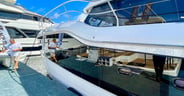
Another trademark feature is the stairway that provides direct access to the foredeck from the flybridge. Typically, Aquila places these stairs on the centerline, but on the 50 they moved them to starboard. Sturdy solid stainless-steel rails are there to help you hang on when descending in a seaway. Cruising shorthanded, these stairs are a good way for the skipper to dash down to the bow and help with docking lines.
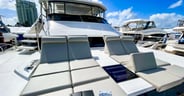
The Aquila 50 Yacht shines when it comes to socializing. It features three separate outdoor social areas to entertain large crowds. The first is the foredeck. Its nearly 300 square feet of space can seat a dozen passengers on sunbeds, recliners, and a long bow bench. Swinging to anchor at happy hour in easterly trades, this will be the shadiest and coolest spot aboard.

The two other gathering spots are the flybridge and the aft cockpit. Read on.
Aft Cockpit
Moving along the wide sidedecks, I was delighted to find tall, solid handrails that fell well to hand and provided a sense of safety on my way to the aft cockpit. When the wind blows on the bow, the cabinhouse and hardtop protect this area. It will be the place to gather for a leisurely breakfast.
The focal point here is a bar that also serves as a transition between the inside and the outside. To port are three barstools. The window just ahead hinges up to the hardtop and a small counter folds down. Voila, the stools now look out onto a bar that faces into the galley. This fun space is reminiscent of resort bars and is likely to become a popular hangout.

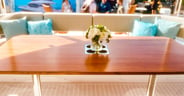
Aft is a full dinette for six with a transom seat. A morning cup of coffee here will be that much sweeter. Just behind this transom bench is a new hydraulic platform. It is designed to carry the tender but also to extend the deck space where you can don snorkel gear or set up lounge chairs. Unlike many other such platforms, this one lowers but isn’t designed to submerge, so a separate hoist is needed to crane the dinghy aboard.
Harvey pointed out that the mechanical parts of the platform are never placed fully underwater. Corrosion from exposure to saltwater should be minimized and potentially lead to less maintenance. Of course, salt spray will still funnel between the hulls and reach the underside of the mechanism, so only time will tell how much protection this redesign provides.

Additionally, a submerging platform is often helpful for older boaters or children to reboard without having to climb a ladder. There are always tradeoffs, and the market will decide how practical this new platform design is.
Aquila 50 Yacht Flybridge Helm
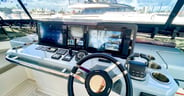
Now on to the third exterior gathering space aboard the Aquila 50 Yacht. The generous flybridge stretches over nearly 500 square feet and is divided into distinct areas. Let’s start with the centerline helm. It is the only command station aboard this catamaran in the standard offering. Twin 16-inch Raymarine multifunction displays (MFDs) are on an angled dash for easy visibility and interaction. A sturdy grabrail is on top of the console to steady the skipper when standing in rough conditions.

The steering wheel and engine throttles are to starboard and two opening hatches are overhead for ventilation and light. Hull #1 has two plush captain’s chairs with bolsters and headrests, but a double bench seat comes standard. Harvey called the twin chairs “a worthy upgrade.”
To either side of the helm are lounges that provide good companion seating but become obstacles during docking if the skipper wants to sight down either side. This is a common problem with centerline helms. Forward visibility is excellent but the sides and aft corners are obscured. Captains will need help from crew or a camera when backing into a slip, but on a yacht of this class, that’s a given. And the image should be super clear on those large Raymarine screens.
Flybridge Social Space
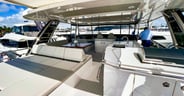
Aquila designed rest of the flybridge for relaxation and entertainment. To starboard is a straight galley that includes a sink, grill, and refrigerator. Designers tucked extra stowage into a cabinet behind the helm seats. An L-shaped dinette for six sits to part. Aft of that is a large sunbed, half of which is protected by the hardtop overhead.

As I mentioned, there’s seating for at least 12 here. Passengers can ascend via either the forward stairs as already described or a molded staircase from the aft cockpit.
Between this flybridge (excellent views), the foredeck (fresh breezes), and the aft cockpit (funky bar), passengers have no shortage of places to escape and enjoy a book or some quiet contemplation.
Living Aboard
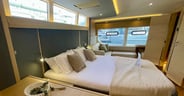
While the exterior of this catamaran yacht is dazzling, the interior won’t be outdone. The 180-square-foot primary stateroom on the Aquila 50 Yacht is possibly the best cabin arrangement I’ve seen on a yacht in this class. This full-beam stateroom is all on one level and is the focal point of the entire forward interior.

The bed is flanked by the head to port and a lounge or optional office and an enviable walk-in closet to starboard. Windows on three sides bathe the suite in light, making it an inviting space to spend time beyond just getting shuteye. This layout is a vast improvement over the 48-foot predecessor, which had the bed on the main level but tucked the head and office down low into the hulls. You had to navigate steep stairs to access them. The only drawback to the new design is that the shower stall is in the bedroom with no separation, which could be awkward.

In the three-cabin configuration, two guest cabins—one in each hull—ensure privacy and still leave room for a utility space with a washer/dryer or a skipper cabin on one side. For charter, a four-cabin/four-head layout is available, but it eliminates the phenomenal forward suite.
A nice salon is just aft of the master, which means passengers enjoy no forward views from this “living room,” but plenty of natural light floods the space. A U-shaped dinette is on port with a straight settee opposite. Buyers can spec a secondary interior helm in the forward starboard corner.
An 800 Ah battery bank is below the salon sole. Also down there is plenty of stowage space for everything needed on an extended cruise, from provisions to spare parts. Onboard systems, including the 20 kW Kohler generator, are monitored by CZone digital switching.
Aquila 50 Yacht Performance and Power
Hull #1 featured upgraded Volvo Penta D6 480 hp engines, but standard power is twin 380 hp D4 diesels. The larger engines are likely to be popular in the U.S. since they push the boat to 21 knots and 3700 rpm. They manage the yacht’s displacement with ease.
For better fuel efficiency, expect to run this model around 3000 rpm and 11 to 12 knots. Depending on conditions, its range at this speed is about 200 miles. If you drop that speed to 8 or 8.5 knots, the range reaches approximately 450 miles. You can see it gets a little fuel-hungry if you’re in a hurry.

An interesting and potentially fuel-saving upgrade is Aquila’s Hydro Glide (AHG) V-shaped foiling system, which will raise about 40 percent of the boat’s weight out of the water. This creates a higher top speed and better fuel economy as well as a less bouncy ride. As usual, there’s a tradeoff. The system requires twin Yanmar 550 hp engines. Hull #1 wasn’t fitted with this system and it’s unclear how many owners will opt for it.
You can also spec the company’s hybrid package. It includes electric motors, diesel range extenders, and a pricey lithium battery upgrade. So far, this is strictly in theory; Harvey had no specifics to share on this option.
Conclusions
Completely redesigned models are somewhat rare these days. Many manufacturers simply stretch, tweak, and re-imagine existing hulls. Why? Because that’s the fastest and most affordable way to keep introducing new models to catch the public’s eye. In this sea of sameness, it’s refreshing to step aboard the Aquila 50 Yacht, which is a culmination of the brand’s expertise and customer feedback.
Of course, the only way to determine if this is the right cruiser for you is to match your needs to the model’s specifics and capabilities. Familiarize yourself with the company, their construction methods, and their warranties. Interview dealers as well as previous Aquila owners about their experience and make sure to crawl through every inch of your specific hull to understand the details and feel secure with your purchase.
The power catamaran segment has exploded in recent decades due to power cats’ space, amenities, and fuel efficiency. Dozens of models are on the market. Aquila alone has launched nearly 1,000 hulls since I first took note of the brand, and that’s quite the success story. I find their newest model to be very livable whether for a weekend or for extended exploring. As for where to put the office? Yeah, I already have plans.
Zuzana Prochazka
You might also like


