7 Reasons to Embark on a Bluewater Adventure

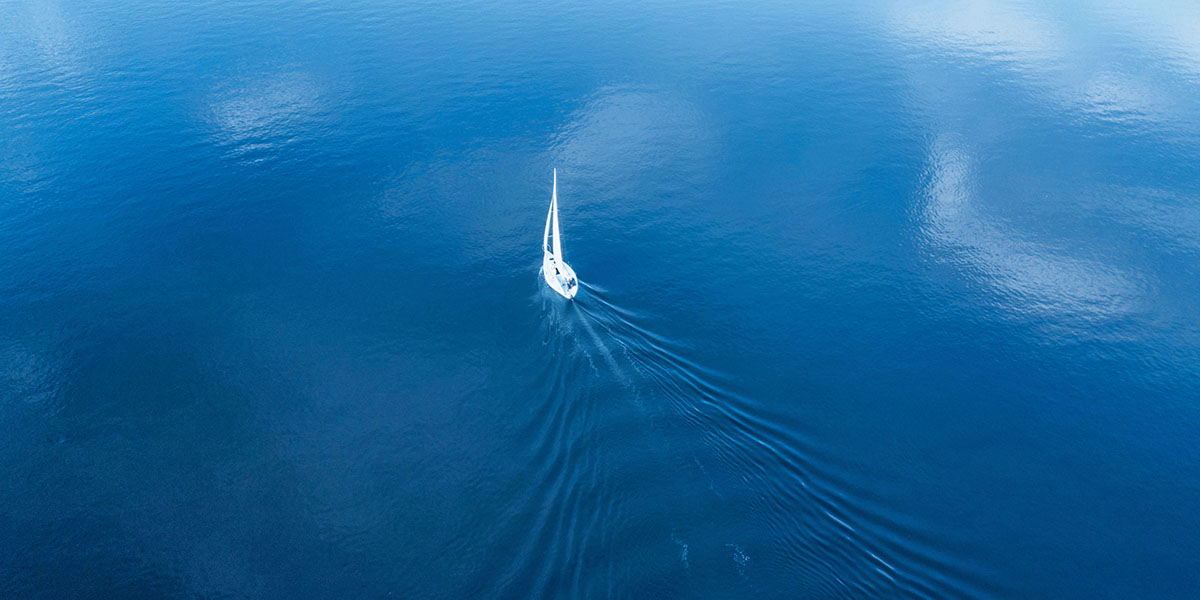
We spend every day of our lives with the horizon line somewhere in our peripheral vision. Many of us ponder what’s beyond it but few dare to find out. That’s especially true when it comes to the oceans. Sure, a bluewater adventure is on almost everyone’s bucket list. But in the end, time usually wins while too many people wait until they are ready.
Time is a thief, stealing adventure and opportunity at every turn. For boat owners who are ready to trade predictability for possibility, here are some reasons to stop wondering and start going. Embark on that bluewater adventure.
1. Connect With the Natural World
Experiencing the open ocean will transform your relationship with the natural world. I remember being in the middle of the Caribbean Sea on a windless day. The water was glass. The sky melted into the sea below and the horizon line dissolved into the blue. It felt like we were the only solid thing in the world, bobbing around like a rubber duck. It was both humbling and exhilarating (and a little trippy).

The only thing that could top it, was the evening that followed. A canopy of stars illuminated the night while phosphorescent phytoplankton lit up like a magic carpet beneath our boat. These are the moments that shape us. I felt like I was being reconnected with the natural world. In the hustle and bustle of sedentary life, it’s easy to forget that we are an inherent and natural part of this world. Taking a trip in the open ocean can help to re-instill simple lessons that have been long lost.
2. Develop Teamwork on a Bluewater Adventure
Embarking on a bluewater adventure will teach you the fundamentals of communication and coordination. You will learn to spot trouble a mile away and know how to respond to it quickly, efficiently, and with the support of others. As a bonus, I can think of no better way to make lifelong friendships and memories.
If you are embarking on this journey alone, you will learn those same skills but within yourself. Without the company of others, you learn where to find compassion, support, and self-rescue from inside.
3. Head Off Regrets (aka Fend Off FOMO)
Sometimes, the only thing more daunting than the journey itself is the regret of never going. This isn’t true for everyone, but for those of us in whom the fires of possibility burn, it’s not easy to pass up a chance to make memories. If you’re reading this article, you may have already opened the door to your possible adventure. And it might just be too heavy to close.
Slivers of golden light trickle in as you imagine the scene of your intended journey. Now, imagine slamming it shut forever. How will that look for the rest of your life?
4. Because You Can
A bluewater adventure requires wanderlust, boundless curiosity, and the power of knowing that you can. You possess each of these qualities. If you start to question your scheduling constraints, financial limitations, and experience level, you will never feel ready. The only preparation you really need is the will to walk to the end of the dock and step aboard. Your bluewater adventure is not a question of if, it’s a question of when.
5. Enjoy the Freedom of a Bluewater Adventure
Freedom isn’t a fixed destination, or a single “perfect” place. Whether you are traveling on foot, by RV, on a motorcycle, or in a sailboat, you are exploring and shaping the idea of what freedom means to you. The journey is the destination. Put yourself in a challenging place, expose your vulnerability, and test your endurance. You will likely find that the ultimate sense of freedom is worth any perceived price you pay. For many people, there is no greater sense of liberation than the sovereignty your soul will find in the open water.
6. Hone Decision-Making Skills During a Bluewater Adventure
So much goes into the planning and undertaking of a bluewater adventure. Navigation is a dance with weather, tides, waves, and currents. As you learn each individual part, you have to be aware of their patterns and interactions with one another. Predictions and decisions must be made based on a variety of factors that will determine scheduling parameters. It’s a complex web of science, safety, leadership, and managerial skills.
Learning to navigate through all of these dynamic moving parts will hone your technical skills as a boater. It will also hone your decision-making and leadership under pressure. You will emerge with a sharpened mindset. This will serve you better on land as well as at sea.
7. Improve Navigation Skills and Brain Health
For too many people, navigation is as simple as opening the GPS app on their phone and hitting “go.” East? West? Who cares? My phone knows, so I don’t have to. This is the mindset of most people as they make their way blindly to their destination.

The hippocampus is the part of the brain that is used for spatial navigation and the formation of maps. This part of the brain helps you recall landmarks, understand where your position is in space, and chart mental maps. It has been replaced by the GPS unit on our phone in most circumstances.
Modern science is shedding some light on the connection between navigational skills and brain health. Acquiring the navigational skills necessary to take on a bluewater adventure will re-awaken your hippocampus. Flexing this mental muscle will contribute to the longevity of your brain health.
You Know Why, but Let’s Talk About When
You may never feel totally “ready” for this journey. But that’s OK, because you don’t have to. You just have to be alive, on a boat, and headed toward that blue. The adventure isn’t about getting to your destination, it’s about partaking in a more engaging life.
But be careful, because these sorts of things can be habit forming. Before you know it, you will be following your dreams, making memories, and pursuing meaningful connections on your next bluewater adventure.
Olivia de Soria
You might also like


