What Are Stepped Hulls?

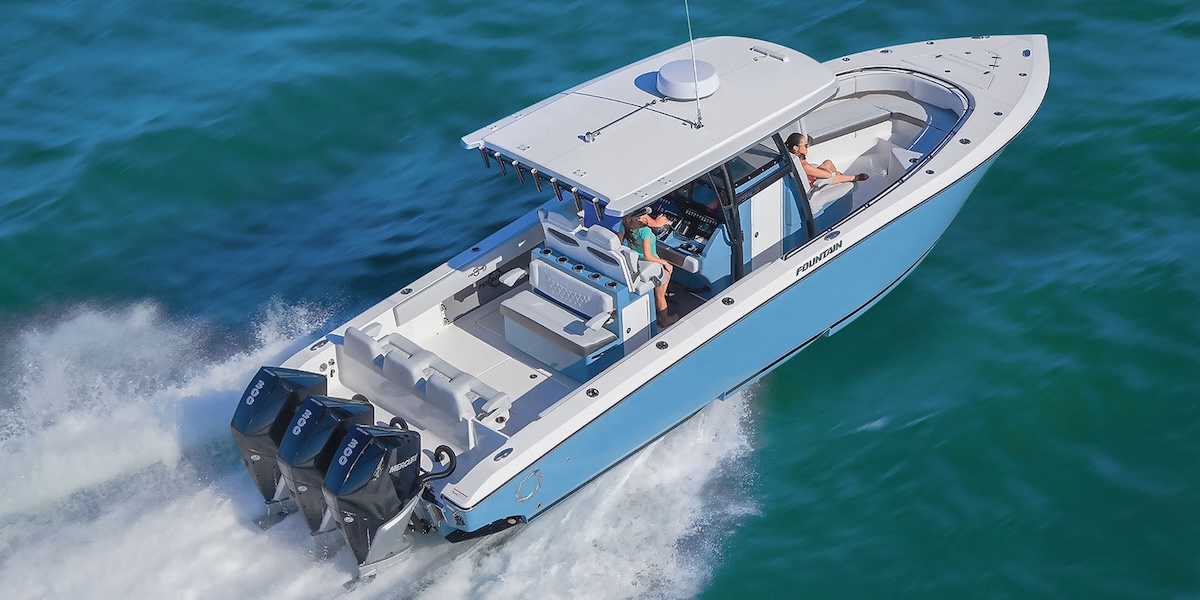
Piloting a high-performance stepped-hull boat such as a Fountain 42 Lightning at 60 mph is an adventure in hydrodynamics. But what are stepped hulls? Put simply, the hull bottom is not a single smooth, unbroken surface but is broken up by transverse steps that help lift the boat out of the water at higher speeds. The steps are often visible as notches in the chines along a boat’s side.
Once you throw down the throttles and get the boat on plane at about 20 mph, the stepped hull shines. It reduces friction with the water by reducing the overall wetted surface, allowing for quicker acceleration and improved overall performance.
Drivers will also notice another significant advantage of stepped-hulls: enhanced stability. The steps improve weight distribution and hydrodynamic efficiency, so you get a more balanced ride.
That’s great in choppy waters, where traditional hull shapes, such as a deep-V, might struggle to maintain stability. Stepped-hull designs often reduce the effects of bow rise, allowing for better visibility and control at speed.
What Makes Stepped Hulls So Popular?
Beyond being faster, stepped-hull boats are very maneuverable. As the boat lifts partially out of the water, it often turns more responsively. This enables sharp, agile handling, which is great for racing boats. It’s also advantageous for recreational boating activities such as watersports, fishing, or navigating crowded marinas where precise control is key.

The stepped-hull boat construction can accommodate various boat styles, from cruisers to high-performance boats such as Cigarette, Donzi, and Fountain. Manufacturers often tailor their designs to focus on comfort and aesthetics while preserving the practical benefits of the stepped hull.
What Is the Typical Power for Stepped Hulls?
How you power a stepped-hull boat depends a lot on the use, weight, and specific design characteristics.
High-performance powerboats or racing boats will pack 300 horsepower to more than 1,000 horsepower. Inboard boats will use a single engine or twins. It’s not unusual to see three or more outboards of 350 hp or more on various models. It depends on how fast the boat is designed to go.
A 35-foot stepped hull designed as a cruiser or for fishing purposes will likely require engine power in the range of 200 hp to 600 hp. That could come from two or more outboards. Some, such as the Scout 357 LXF, are rated for up to 1,200 hp.
What Are the Primary Uses for a Stepped-Hull Boat?
As noted, the design of stepped hulls enhances performance and reduces drag, allowing for faster cruising speeds. This makes them ideal for high-speed outings like Poker Runs or organized racing.
But don’t pass up stepped hulls for fishing, watersports, or family cruising. The speed is appealing to get to the fishing grounds, and the design’s stability in rough water is good for families.
The size and construction of a 35-foot boat, for example, can make it suitable for coastal exploration and harbor hopping. Maybe even for short offshore trips, provided it has the necessary equipment and safety features. Some owners use their stepped-hull boats for chartering activities, such as sightseeing tours or private events. They leverage the boat’s speed and comfort to attract clients.
Reasons to Buy a Stepped-Hull Boat
A whole lot of boaters would love to improve their boat’s top speed and fuel efficiency. Who doesn’t want to go faster on less gas? Steps create a break in the hull, allowing the boat to ride on top of the water rather than forcing the hull through it. This reduces drag, increases speed, and saves fuel.
Using a 35-foot boat as an example, it typically offers enough space and capabilities to serve multiple purposes. It can be a day cruiser, a fishing boat, a watersports facilitator, or a weekend getaway platform. And while stepped hulls are designed for speed, they do offer a stable ride. Many have been engineered to maintain control and comfort in choppy waters, making them suitable for coastal and inland excursions.
The sleek lines of boats with stepped hulls offer an aggressive and sporty look that many boat enthusiasts find attractive. And a 35-foot stepped-hull boat could have strong resale value. The demand for performance-oriented recreational boats often holds up well in the second-hand market.
Reasons Not to Buy a Stepped-Hull Boat
Stepped hulls can be more responsive to steering inputs, which means they might turn sharper or behave differently at various speeds. This can require a slight adjustment in how an operator handles the steering.
At certain speeds, stepped hulls may experience porpoising, which is a bouncing motion caused by the boat alternately rising and falling. This can be alarming for inexperienced operators and may require skillful throttle management to mitigate.
The distribution of weight in the boat can greatly affect performance. Incorrectly balanced loads on stepped hulls can hinder the boat’s ability to achieve its intended speed and efficiency.
Overall, a 35-foot recreational stepped-hull boat can be a great investment for those seeking a versatile, efficient, and performance-oriented vessel for a wide range of boating activities.
Top image courtesy of Fountain Powerboats.
Doug Thompson
You might also like


