Yes, You Can Use a PWC for Watersports

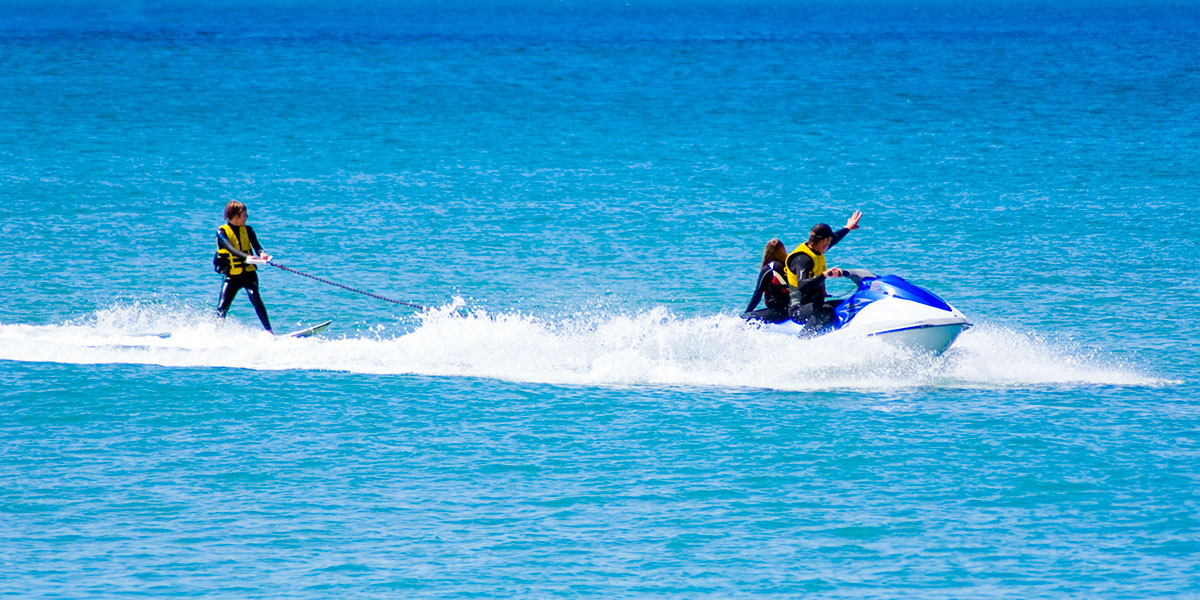
Watersports enthusiasts often think “bigger is always better.” (They’re not alone.) But for people on a limited boat budget and those who enjoy a variety of waterborne activities in addition to towed watersports, a personal watercraft (PWC) is often the way to go. Wait. A PWC for watersports? You bet.
Let’s look at what PWCs can do for you in terms of watersports. What are their limitations? How much can you expect from a watersports PWC? What do you need to watch out for?
What Is a PWC?
The terminology around personal watercraft or PWC often gets confused. Most people refer to them as jet skis. However, Jet Ski is a brand of PWC under the Kawasaki umbrella. Yamaha’s PWCs are called Waverunners. Sea-Doo is the other primary manufacturer of PWCs.
We still call them “personal” watercraft, but these vessels are actually getting bigger. Two-seaters have long been popular. Today, three- and even four-person PWC models are widely available. The operator and passengers sit or stand.
An inboard jet propulsion drive propels the craft. The engine sucks water in on the bottom of the vessel and then shoots it out the back, pushing the craft forward.

Advantages of Using a PWC for Watersports
PWCs have been referred to as the “gateway drug” for getting people into boating—and for good reason. For starters, they’re among the most affordable types of motorized watercraft out there. Some cost less than $10,000. Even the most expensive model isn’t likely to go much over $20,000.
Besides that, a PWC can be used almost anywhere you have more than two H20 molecules to rub together. Smaller bodies of water, areas that are inaccessible to larger craft, and tucked-away coves are all easily navigable for PWCs.
For this reason and others, PWCs are ideal for beginners and children to learn watersports. Even the most powerful PWCs create smaller, much more forgiving wakes than larger watercraft. Plus, finding a private area to learn can take a lot of the pressure off.
On a three-seat PWC model, the spotter is more visible and the vehicle is very maneuverable. You can quickly turn around to pick up downed riders. You can also easily zip back to shore to swap out riders.
Watersports You Can Accommodate on a PWC
With the exception of wakesurfing, you can accommodate about any towed sport using a PWC. Why not wakesurfing? It requires specialty wake plates and tons of ballast—those boats are heavy—to create a surfable wave. And it requires speeds of 10 to 12 mph. Going slow is not a PWC’s strength.

Most manufacturers have PWC models that can reach speeds of 60 mph. That is plenty of juice to tow a wakeboard, a tube, or a waterskier. Many newer models even come equipped with “ski mode” presets to facilitate various watersports, speeds, acceleration, and skill levels.
Wakeboarding
The ideal speed for wakeboarding depends on the wakeboarder’s size and skill level; typically, it’s between 15 and 25 mph. That means most PWCs are fully capable of towing a boarder. Expert wakeboarders will appreciate a PWC’s ability to make tight turns and reach less accessible areas. They won’t have the tall, sharp wake that specialized boats create, of course, because a PWC lacks the weight and tabs/plates to create it, but if they want speed and action, a PWC provides.
For basic wakeboarding and beginner wakeboarders, most PWC models are more than adequate.
Waterskiing
Expert-level waterskiers prefer speeds of more than 30 mph. Barefoot skiers need to reach 40 mph or more. Beginners like to go about 20 mph. PWCs are quite capable of all of those speeds. People who are just learning or who are interested more in slalom or trick skiing will appreciate lower speeds combined with a PWC’s agility. They are a great mix.
Keep in mind that if you plan to use your PWC for skiing or wakeboarding, you’ll probably need to equip it with a tow pylon or, at the very least, a ski tow eye.
Tubing
Tubing is, of course, the easiest watersport for riders of all ages. Given a PWC’s wide speed range, it’s a great facilitator of tubing. Consult your owner’s manual for weight limits and towing capacity, though, since tubes create a lot more drag on the watercraft than other watersports. Most modern models come standard with a tow eye for just this purpose.
Disadvantages of a PWC for Watersports
To be clear, not every PWC model is suitable for watersports activities. If you have your heart set on watersports, check with the manufacturer before you buy a PWC, especially if you’re considering a smaller model.
Just as the PWC’s advantages mostly stem from its size, so, too, do its disadvantages. You can only take out a couple of other people at most, which may limit the fun. Plus, simply riding a PWC requires some physical exertion, so it’s not as relaxing as riding in a boat. A PWC limits how much time you can spend on the water at a time. PWCs have no lounge seating. They have limited space to store refreshments. They provide no cover from the sun.
For many buyers, the PWC is an attractive less expensive “boat” option that facilitates watersports—or fishing or cruising—is easier to store and transport, and can access all manner of waterways.
Kurt Brighton
You might also like


