Is it Time to Add a Bimini Top to Your Pontoon?

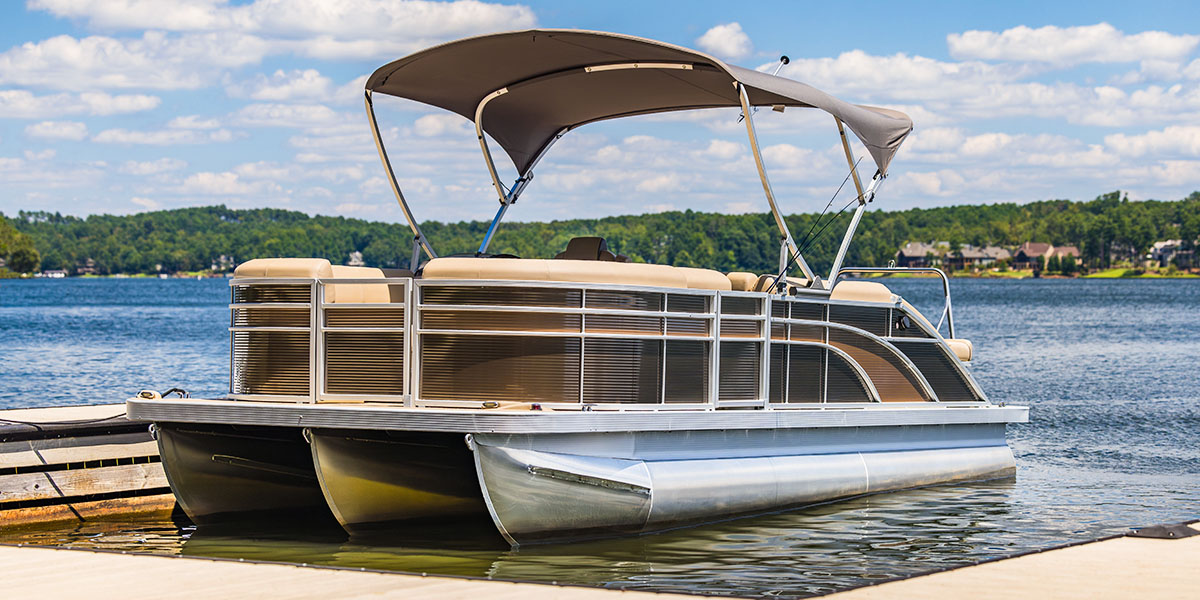
We know boating enthusiasts are people who love the outdoors. But even the most enthusiastic boat enjoyer needs a break from direct sunlight now and again. That’s where pontoon Bimini tops come in.
For pontoon owners, the after-market possibilities for adding a Bimini are nearly endless.
Keep reading to find out the answers to your questions. What are Bimini tops for? Why might you want to add one to your pontoon? What should you expect, depending on what type you choose?
What Is a Bimini Top?
Pontoon Bimini tops are usually made of canvas, supported by collapsible aluminum rods, and come in a variety of sizes and configurations. Yes, they are named after the Bimini region of the Bahamas island chain. Prices for Biminis range from about $150 for a basic, manual model up to $2,000 for a powered one.
Lots of pontoons come with Bimini tops standard or as add-ons, but most boat owners would probably agree that some sort of sun shade is essential, not optional. A few of the important reasons they are considered essential include sun protection, comfort, and savings.
Sun Protection
Even if you’re slathering on a triple coat of sunscreen on an hourly basis, you just can’t spend an entire day exposed to direct sunlight. You won’t find a substitute for the protection of simply being in the shade.
Comfort
Certainly part of the draw of inviting friends and family out on the boat is to enjoy the sun. But if you’ve ever spent a hot August day waiting in line at, say, an amusement park, you know that direct sun exposure quickly wears on you. The Bimini top gives people the option to duck out of the sun for a bit and recover.
Savings
A Bimini top is the most affordable means of providing sun shade on a pontoon. The alternatives are building a whole cabin or installing what’s called a dodger—a sort of canvas and Plexiglas “cabin.” Both are pricier than a Bimini as well as more intrusive.

Pontoon Bimini Tops Options
Bimini tops are offered across a spectrum of sizes, quality, prices, and more. The range of choices is vast, so take a look at a few of the major categories.
Quality
You want a Bimini top constructed of fabric that can withstand the elements and not buckle in a strong breeze. Some key features to look for include:
- Marine-grade 600D polyester
- Double stitching
- A durable aluminum frame that comes with a storage boot for when it’s not in use
Some top user-rated brands for utilitarian quality include Naviskin and Leader Accessories.
Size
Measure twice and cut once. Refer to your boat’s manual and double-check with the Bimini manufacturer before you order. Also, consider how much coverage you want. Biminis most commonly come in either two-, three- or four-bow models. OK, but what’s a bow? They are the upside-down U-shaped cross pieces that hold up the canvas. So a four-bow model is longer than the others when it is deployed.
DIY Compatibility
When you’re ordering a new or replacement Bimini top, take a moment to check the reviews. Are people complaining about how difficult it is to assemble and install? What are their issues? Generally speaking, installation shouldn’t take more than a couple of hours. But the fact is, some Biminis have a better reputation for ease of installation than others. MSC is one brand that consistently gets high ratings for how easy its Biminis are to install. Read the installation instructions, but you can expect to need the following:
- Power drill
- Drill bits, including a countersink bit
- Screwdriver
- Tape measure
- Box wrench set
- Sealant
- Manufacturer’s hardware and fasteners
Fancy Pontoon Bimini Tops
Up to this point, we’ve discussed Bimini tops that are manually deployed. But there’s a realm of powered Biminis that can be deployed or retracted with the touch of a button. Imagine how an automatic convertible car top works.
These remote-controlled tops are nice. Many boaters want them for the convenience, and those with mobility issues may need them. Keep in mind, however, that they cost roughly 10 times that of a standard Bimini, and installation is going to be commensurately more complicated. Manufacturers such as Sureshade claim that it remains a DIY operation.
No matter their complexity or cost, pontoon Bimini tops keep passengers comfortable. And they will keep you, as the boat operator, out of the sun. Given the number of aftermarket options, you should be able to find one that suits your needs.
Kurt Brighton
You might also like


