What You Need To Know About Sailing Catamarans

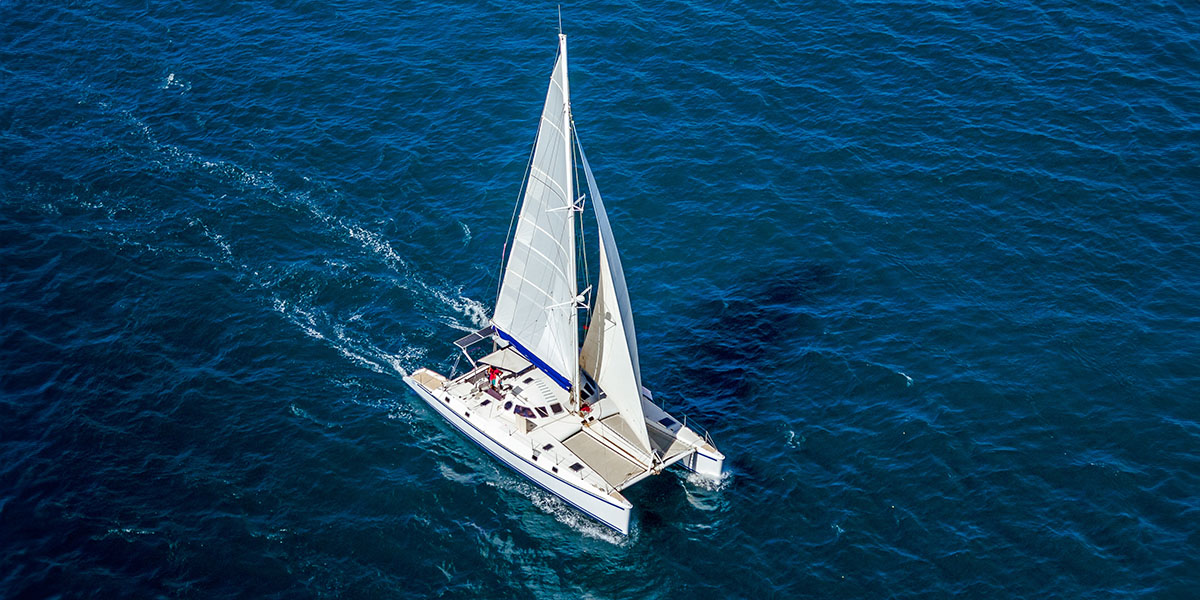
For sport and recreation, sailing catamarans are a relatively new player on the field. And where you used to see only one or two standing out at an anchorage in the Bahamas, now you will see the majority of boats boasting two hulls. Or as my daughter says, two bananas.
The fact is, their popularity is a direct reflection of their outstanding functionality and performance.
What Is a Sailing Catamaran?
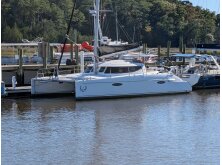
A catamaran is not dissimilar to a sloop, but instead of one hull, they have two. Those two ‘bananas’ are multifunctioning hulls serving as living quarters on catamaran yachts while simultaneously rendering the vessel unsinkable with airtight compartments in each hull.
What Makes Sailing Catamarans So Popular?
Catamarans have two histories. Their modern history only goes back to about the mid-20th century. But the Wayfinders of Polynesia have been circumnavigating on their two-hulled sailing vessels for longer than 1,000 years. The popularity of catamarans in the South Pacific stemmed from their shallow draft, stability and safety, capacity and cargo space, speed, and maneuverability. All of those characteristics that made catamarans popular so long ago are exactly what make them popular today.

What Is the Typical Power for a Sailing Catamaran?
If you’ve ever taken a beach vacation and stayed at a resort, maybe you have seen the little boats for rent in the back. Their seating area looks like a small trampoline sitting on two bananas. They are small, often under 20 feet. For the most part, these are the only catamarans without engines.
Most catamarans are 36 feet or above, and at 38 feet, they technically become a yacht. In my opinion, the most attractive characteristic of a catamaran, even a sailing catamaran, are the two inboard diesels that come with the boat. Each engine is a safety net in case something goes wrong—a near inevitability—or if the wind becomes unfavorable.
I used to own a monohull, and I can tell you that engine dilemmas feel vastly different on a catamaran than on a monohull. When one engine starts acting up on a catamaran, no problem. You just run on the other engine until you get the first sorted out.
What Are the Primary Uses for a Sailing Catamaran?
Like sloops, catamarans can be used for a myriad of sailing varieties. They are best known for recreational sailing, long-distance cruising, living aboard, racing, charter exploration, fishing, and more. Catamarans can vary immensely from one to the next. One catamaran can be a multilevel unit equipped with scores of crew in matching shirts. Another can be a simple 38-foot sailing vessel with three rooms to comfortably accommodate a small family living aboard.
I can tell you from experience that a catamaran is going to be the best option for families that want to live aboard. The floor plan offers the most functional and comfortable living space.
Their stability at anchor is a huge benefit for anyone planning to live aboard.
Something You Might not Expect…
There are a few things to keep in mind before you buy that catamaran. First, they don’t sail quite as close to the wind as a monohull. They can comfortably sail about 30 degrees off the wind, where a sloop can get as close as 15 degrees, sometimes even 10, off the wind. That may narrow your angle of sail slightly.
Another unexpected quality of a catamaran: their motion. In general, they are known for being the most stable boat, which naturally implies a more comfortable sail. But where a monohull slices through the water, a Catamaran bobs along the surface, often generating an uncomfortable motion at certain sail angles.
Definitely Consider a Sailing Catamaran If…
Do you have a family? Are you considering spending an entire season aboard your vessel, or even moving aboard full-time? A small monohull offers barely enough room to sit down. But a catamaran is basically like living in a small apartment. It’s game-changing.
Even if you don’t have a family, you can still enjoy the benefits of spacious living quarters and the striking figure your vessel will cut in the foreground of a watery sunset.

Definitely consider a catamaran if you plan to sail to the Bahamas or another shallow-water destination. The crystal clear waters of the Bahamas, the Exumas, and the Ábacos are much easier to explore in a shallow-draft vessel. The shallow draft will allow you more options for protected anchorages. Some catamarans even offer dagger boards that pull up, allowing you to literally beach your boat on the sands of a perfectly pristine white sand beach.
Maybe Consider a Different Type of Sailboat If….
If you plan to keep your boat at a slip or in a marina, a catamaran is going to cost you more money and headaches than a monohull. Given the wide berth, you will often be charged double, if the marina can accommodate you at all. In Florida, south of Boca Lake, there aren’t really any marinas that can accommodate a catamaran at slip. They just don’t have wide enough slips.
Sailing catamarans are good for being at anchor. They are stable with a shallow draft, widening your anchoring options exponentially. But at a marina, not only are they more expensive to dock, they are twice as wide and difficult to maneuver in tight spaces made for monohulls.
Find Multi-Hull Boats For Sale
 Olivia de Soria
You might also like


