4 On-the-Water Historical Landmarks Accessible by Boat

Grab your boat, life jackets, tow rope, and your tool(s) of choice—a tube, wakeboard, skis—and have an adrenaline-packed day on the water. Not for you? Maybe a pontoon boat is more your speed. Gather some friends and family, pack some food and drinks, and enjoy that chill “party boat” experience. Still not you?
Try something completely different and let your inner history buff take the wheel. Plenty of interesting sites and structures are on or near the water and accessible by boat. Boatmart found four on-the-water historical landmarks you can visit by boat. They are either viewable from the water or accessible on foot after docking the boat a short distance away.
Sturgeon Bay Ship Canal and Pierhead Lighthouse
This ship canal, located in the quaint tourist spot of Door County, Wisconsin, was built in the 1870s and is one of the country’s largest working maritime landmarks.
It was constructed to allow ships safe travel from the mainland to Washington Island on Lake Michigan while skipping a trip down the Death’s Door Straight. The strait is one of the most dangerous areas in any of the Great Lakes with its tall waves, strong winds and hidden shoals. Not a great environment for late-19th-century ships.
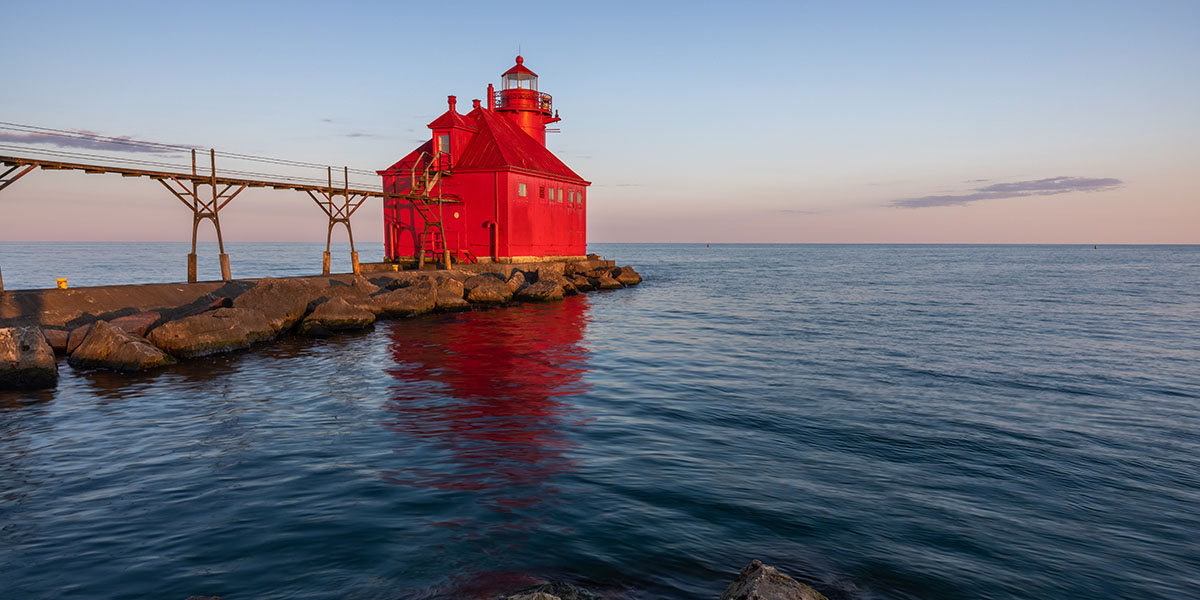
This landmark comes with some bonuses. Two iconic lighthouses are nearby: Pierhead (pictured above) and Sherwood Point. So is a nature preserve with more than two miles of trails.
Mallows Bay-Potomac River National Marine Sanctuary
This is one of the on-the-water historical landmarks that is reachable only by boat, so you have a leg up on other adventurers already.
The nearly 200 “Ghost Ships” of Mallows Bay—the bay and wrecks are about 40 miles south of Washington, D.C., in Maryland—make up the largest collection of shipwrecks in the Western hemisphere.
Some were built as part of an emergency fleet as the United States entered World War I but were deemed surplus to requirements by the government. They were sold, stripped for parts and buried in Mallows Bay. Other ships in the bay date back as far as the Revolutionary War.

Several of these ships can be seen above the water. As they’ve rusted and decayed, they have become their own ecosystems. They are home to different types of vegetation and wildlife.
The area has become a popular fishing destination as well. So hang around a little while longer and wet a line.
Dry Tortugas National Park
Sections of this national park, located about 70 miles west of Key West, Florida, are accessible only by boat. More than that, your vessel “will provide you with the most opportunities to explore” the park, according to the National Park Service.
Check out Fort Jefferson, a 19th-century marvel of American military architecture. The largest all-masonry fort in the U.S. was built in the mid-1800s to protect the gateway to the Gulf of Mexico.

Despite never being finished, the fort’s brickwork and more than 2,000 arches are worth the trip. After your history lesson, hang around and admire the striking colors and wildlife in the local reef system. It is the third-largest coral reef system in the world.
Overnight camping and personal vessels require permits, so plan ahead and know the regulations.
The Golden Gate Bridge
Perhaps the most famous bridge on the planet, The Golden Gate has been called the most beautiful bridge in the world. If only for its mammoth size, a trip past this piece of U.S. engineering history is a can’t-miss opportunity.
The Golden Gate Bridge Highway and Transportation District describes it best: “With its tremendous towers, sweeping cables, and great span, the Bridge is a sensory beauty and engineering wonder featuring color, sound and light.”
The Golden Gate was constructed during The Great Depression. It extends 1.7 miles across the San Francisco Bay and reaches as high as 746 feet above the water. It weighs more than The Empire State Building.
Perhaps the wildest fact about the bridge is that each cable consists of 27,572 wires. If the wires were extended together in one continuous length, they would wrap around the Earth more than three times.
The construction itself isn’t the only thing to marvel at, though. The clouds and mist that hover over the bridge while thousands of cars pass back and forth make it beautiful just to stop and stare.
There’s more to boating than thrill-seeking and day cruising on summer afternoons. Get on the water and visit on-the-water historical landmarks, including some of the most famous places in American history.
Andrew Hanlon
You might also like