5 Features of Trolling Motors That May Surprise You

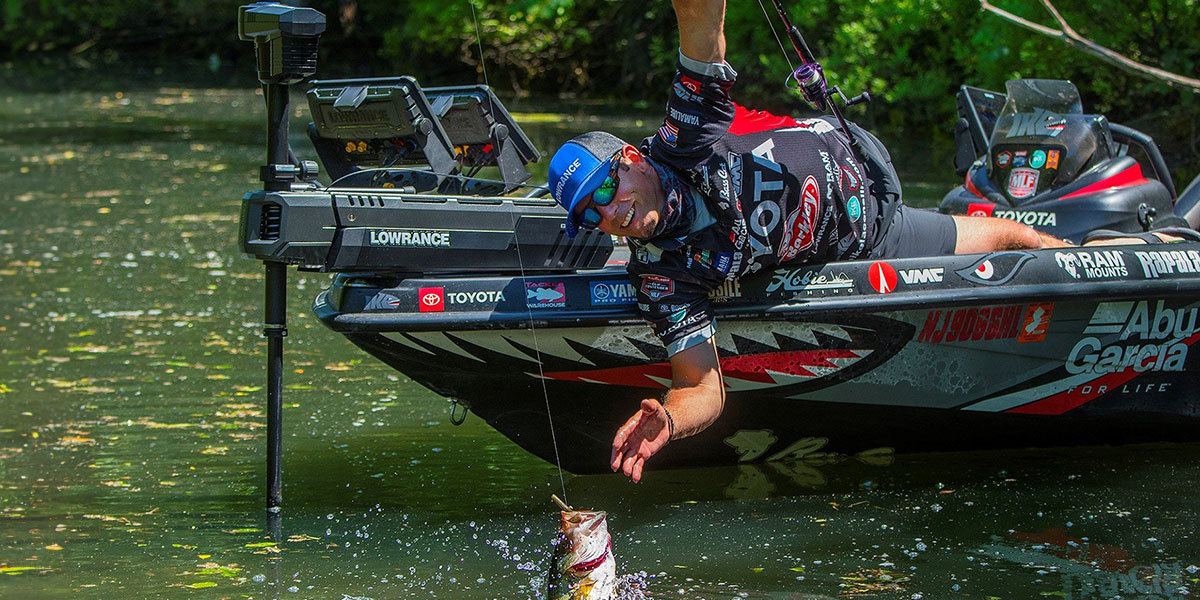

The boats used by competitive tournament anglers are definitely impressive. Yet, some of the most sophisticated technology on board isn’t bolted to the dash or screwed to the transom. Much of it hides in plain sight: inside the electric trolling motors. How much do you know about today’s trolling motors? Boatmart has the lowdown on five features of trolling motors that may surprise you.
1. Trolling Motors Are Powerful
For starters, many people are shocked to discover just how powerful trolling motors are. Modern coreless and brushless trolling motors can generate as much as 100 pounds of thrust. That’s more than enough oomph to push heavy bass boats through the thickest cover with ease, or hold high-sided walleye boats in place on the windiest days.
But the big benefit is that in everyday use you can operate the motor at a much lower power setting. It will be quieter and stealthier than a less powerful motor operating at a higher output setting. And since the more powerful motor is simply coasting along rather than working up a sweat, it will deliver extended battery life.
2. Trolling Motors Are Silent

The silence of today’s electric motors is one of the five features of trolling motors that surprises many people. Old-timers like me remember the audible whirr-thunk noise of previous-generation motors that tended to wake up every fish within 100 yards. But that’s no longer the case. Today’s electric trolling motors are far quieter than their ancestors were and give anglers an edge, especially when fishing in calm, shallow waters.
3. Trolling Motors Can Auto Stow and Deploy
The auto stow and deploy feature on some high-end electric motors also tends to surprise a lot of anglers. You can stow the trolling motor at the touch of a button—or by tapping the touchscreen of a compatible dashboard multifunction display (MFD)—before you head off to the next spot and quickly deploy it again when you get there.
Apart from saving a bit of time and eliminating the need to manually lift the motor, auto stow and deploy protects against accidental damage if you forget to lift the trolling motor before you hit the gas on the big outboard.
4. Trolling Motors Communicate With the Boat’s Electronics
The most impressive and surprising feature of today’s high-end electric trolling motors is their ability to communicate with the rest of the boat’s onboard electronics. High-end motors such as the Garmin Force, Lowrance Ghost, and Minn Kota Ulterra, for example, can digitally anchor the boat on a given spot. They then use the boat’s GPS to continuously monitor its exact position and automatically engage the motor as required to keep the boat in position.
Some motors can hold the boat on a given heading, keeping the bow pointed in the same direction at all times to prevent anglers onboard from casting over one another. Some can hold position and heading at the same time to really lock the boat in place. A few models will even work collaboratively with shallow-water anchor systems for next-level command of the boat.
Communication with the GPS can go one further. Trolling motors such as the Garmin Force can follow precise trolling routes loaded into the GPS. There is no more precise way to carefully work along a piece of underwater structure that you found on a contour chart.
Intrepid anglers can also link a motor nose cone with an integral transducer to the boat’s main sonar. Some motors, such as the Lowrance Ghost, even offer upgradable nose cones with a high-end Active Imaging 3-in-1 transducer for picture-like views below, to the side, and the full 360 degrees around your boat.

Communication with the MFD goes two ways, of course. You can continually monitor things like the charge level on your deep-cycle batteries, the water temperature, or readings from a nose-cone transducer right on the big screen.
5. Trolling Motors Communicate with Peripheral Devices

The motor doesn’t have to communicate with the dashboard or bow-mounted MFD, of course. Motors such as the Minn Kota Ulterra can just as easily communicate with a compact remote control that can fit in a pocket or hang from a lanyard. Anglers can wirelessly control the motor from anywhere on the boat.
For the ultimate in stealthy control, Garmin’s Force and Force Kraken trolling motors can connect to a Garmin smartwatch. Then, to make minor adjustments, simply tap the smartwatch screen on your wrist.
Electric motors have come a long, long way, and they continue to evolve at a rapid pace. Manufacturers keep bringing new features and capabilities to anglers looking for an edge. These five features of trolling motors are just the beginning.
Craig Ritchie
You might also like


